
🐠 Snorkeling in Phu Quoc – Southern Islands Without the Crowds (Complete Guide)
Updated: Jul 27
Phu Quoc is known for its beaches, resorts, and sunsets.But the real life of the island doesn’t begin on a sunbed.
It begins under the surface.
Just 20–30 minutes by boat from An Thoi harbor, the world of hotels disappears.The sea gets deeper. The water becomes clearer. The seabed turns rocky. And right here — between the cliffs and coral formations of the southern archipelago — you’ll find the best snorkeling in Phu Quoc.
Not every island is the same.Not every hour of the day offers the same conditions.And not every tour shows you the best spots.
In this guide, I’ll show you:
where to snorkel without crowds
when to go for the best visibility
what the morning vs. afternoon program looks like
what to bring (and why)
why coral bleaching happens
and how to turn this into a truly memorable experience
Because snorkeling here isn’t just an activity.It’s the moment when the world goes quiet.
🌊 Best Islands for Snorkeling Without Crowds in Phu Quoc

The southern archipelago of Phu Quoc includes more than a dozen islands. But only a few truly offer quality snorkeling away from mass tourism.
These are the islands I personally choose when the goal is clear water, healthy coral, and fewer boats.
🐠 Hon Gam Ghi – From Abandoned Paradise to a Living Reef Experience

Hon Gam Ghi once felt completely untouched.Today, it is slowly developing — a few simple restaurants, basic facilities — but once you enter the water, it’s still all about the reef.
Coral conditions here are mixed.
In some areas, you’ll find dense coral fields.In others, parts of the reef are damaged or dead. That’s why knowing exactly where to enter and at what depth makes all the difference. Sometimes even at just 0.5 meters, the structure of the seabed changes and the coral becomes significantly richer.

What you can experience here:
dense hard coral formations
soft corals in protected sections
sea anemones
reef fish activity
a mix of rocky and sandy seabed ideal for reef growth
Underwater life here is still surprisingly alive and dynamic.
Visibility is best in calm morning conditions, and often again later in the afternoon when the sea settles.
For us, this is usually the first stop.The depth is manageable, the conditions are stable, and it’s the perfect place to test equipment before moving to deeper reef sections.
🌊 Guided Underwater Circuits

With us, it’s not just a “swim stop.”It’s a guided underwater experience.
At Hon Gam Ghi, we operate two main snorkeling circuits depending on daily conditions:
Northern circuit – more rugged rocky formations, denser coral sections, higher concentration of fish
Southern circuit – large rock structures transitioning into sandy areas with calmer sections closer to the beach
The route is always selected based on:
wind direction
current strength
water visibility
boat traffic in the area
There is no fixed map. We follow the sea.
And that’s the difference between an average tour and a truly powerful underwater experience.
🐚 Hon Buom – The Best Snorkeling in Phu Quoc’s Southern Islands

If there is one place in 2026 that truly delivers a “wow effect” for snorkeling in Phu Quoc, it’s Hon Buom.
While other islands struggle under tourism pressure, Hon Buom maintains exceptional reef health thanks to its location and stronger currents. The water moves, cleans itself, breathes. And the reef grows.
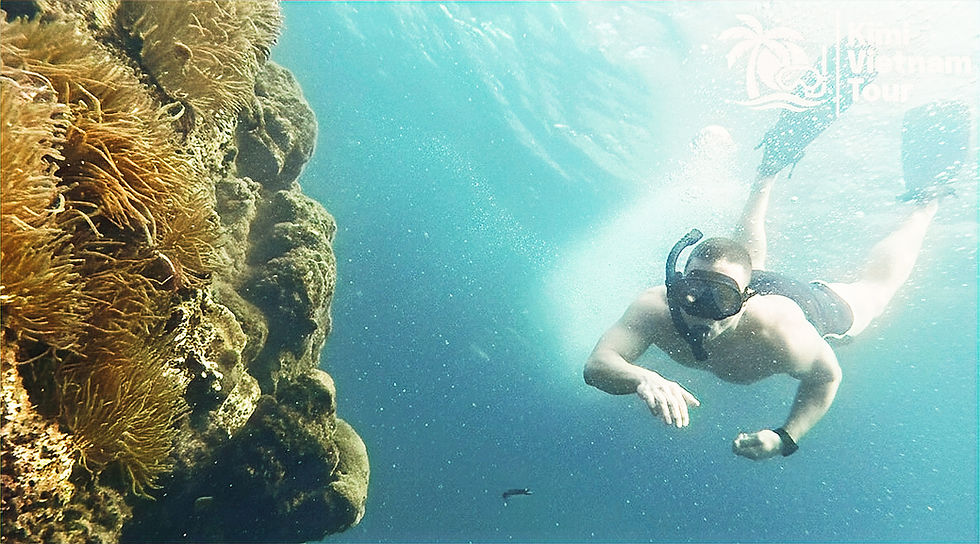
Soft corals are thriving here.Entire carpets of color sway in the current — from deep purple to neon yellow. Underwater, it feels like a living garden in motion.

On the northeast and western sides of the island, you’ll find vast fields of sea anemones. Not just a few patches - square meters of them. And in nearly every second one, a family of clownfish weaving through the tentacles, often swimming right up to your mask.
Hard corals form deeper structures and small canyons where schools of tiny blue reef fish gather. Occasionally, you might spot a moray eel peeking from the shadows.
And visibility?
It can vary depending on the currents - the same currents that keep the reef alive.But we know where to go and when. That’s the difference.
With Us, It’s More Than Just a Stop
At Hon Buom, we don’t just anchor the boat and let you swim.
Our instructor guides you on an underwater snorkeling circuit around the healthiest, most vibrant sections of the reef.We have two routes and choose between them depending on sea conditions.
If the sea is rough, we move into the lagoon.If it’s calm, we head to the more open reef sections.
Early morning or afternoon - we always allow enough time and space to show you the very best this island has to offer.
And that’s exactly where we go.
🌴 Hon Mong Tay – Beach Beauty vs. Real Snorkeling

Hon Mong Tay remains one of the most beautiful islands above the surface. Turquoise water, white sand, postcard views.
But the reality is a bit different from what you often hear.
Most of the big tourist flow now heads toward May Rut Trong, which means the regular local visits to Mong Tay are actually less crowded than many expect. That’s the good news.

Don’t expect strong coral right off the main beach. That area is weaker.But move a little further out - when you know where to go - and it becomes a completely different story.
Massive porites formations, soft and hard corals, sea anemones, small and larger reef fish of many species. In certain sections, the reef is surprisingly vibrant and alive.
The island has its “but.”
Outside the maintained beach areas near restaurants, parts of the shoreline can feel less cared for, and natural debris from the sea is simply something you can’t control. It’s not a polished resort island.
And maybe that’s exactly why the underwater world still works.
Where the coastline isn’t heavily modified, the water is often the cleanest. Once you slip below the surface, you can find beautiful gardens of soft and hard corals that truly surprise.
There are currents here. So you need to know where and when to enter the water.
With Us, Mong Tay Is More Than Just a Beach Stop
On our trips, Mong Tay is often the final stop - a place to relax, swim, and enjoy the atmosphere after more active snorkeling.

But if you want more, the instructor can take you further out to the coral sections.
We have three underwater snorkeling routes here and choose between them depending on weather, currents, and timing.The best conditions are usually early in the morning or later in the afternoon.
Sometimes we even choose Mong Tay as our first stop instead of Gam Ghi - because under the right conditions, the bay itself can be absolutely worth it.
🏝 Hon Dam Trong & Hon Dam Ngoai - The Real Robinson Island

Hon Dam - often called “Robinson Island” - remains one of the last truly off-the-grid spots in the southern Phu Quoc archipelago.
No large resorts. Limited electricity.Minimal signal.
In 2026, Hon Dam is divided into two parts:
Hon Dam Trong (Inner Island)
Hon Dam Ngoai (Outer Island)
A Wild, Healthy Reef
Hon Dam Ngoai holds some of the best shallow acropora coral gardens in the area. Large,

flat coral fields stretch across shallow sections and remain in very good condition.
On the southern and southeastern sides, stronger currents prevent sediment from settling, keeping the hard coral formations clean and thriving.
This isn’t a quick swim next to the boat.This is real reef exploration.
Life Below the Surface
The seabed is rugged, with rocks and small caves that create natural shelter for marine life. You’ll see various damselfish, clownfish in large anemones, and with some luck, small stingrays resting in sandy patches between coral sections.
It feels raw. Natural. Less disturbed.
The Island Reality
Around the homestay area, everything feels

like a small bamboo paradise. Outside that zone, parts of the coastline sometimes collect plastic brought by currents from the mainland.
It’s not a polished, resort island.
Underwater, however, Hon Dam is strong.
In 2025, new coral monitoring stations were installed and anchoring began to be more regulated. By 2026, the positive impact on reef condition is already visible.
With Kimi Vietnam Tour
With us, you may experience Hon Dam as the final stop of our tours.
It’s a place for both relaxation and quality snorkeling. And if you want more, our instructor will take you to the best reef sections - choosing the right entry points depending on conditions, currents, and timing.
Hon Dam isn’t about luxury. It’s about authentic island atmosphere and a powerful underwater world.
🌿 Hon Kim Quy - The Best Snorkeling Without the Crowds

Once one of the most beautiful snorkeling spots in the south. Today? It’s a bit up and down.
Not everything is perfect anymore - nature changes, seasons shift, and the sea has its own rhythm. But if you know where to go, you can still find a truly exceptional underwater world.
In fact, it remains one of the best places on Phu Quoc to observe a large coral reef system.
We know where to go.

After years on the water, we know where the reef is truly alive and where snorkeling genuinely makes sense. This is our best starting point, chosen based on real conditions - not guesswork, not a map.
And yes - it is still a massive coral garden.Extensive, vibrant, and full of structure, creating a real underwater world beneath the surface.
There is real life down there.
For those who want to see true anemone gardens - huge colonies with countless clownfish clans - together with an impressive diversity of coral species, and all of it without crowds, this is absolutely the best choice.
What truly makes the difference?

When you go with us, you’ll often be the only tour boat near the island. Just a few local fishing boats on the horizon and open sea all around.
Our underwater instructor guides you calmly through the most vibrant areas, with patience and deep respect for natural beauty. No rushing. No chaos. Just space to observe.
We have our own carefully selected spots — including our guided underwater circuit — and that’s where it truly makes sense to enter the water.
And one important thing:
We always anchor away from coral structures.Never on living reef. Never on fragile formations.

Corals grow for years — sometimes decades. A single careless anchor can destroy what nature took so long to build. We make sure that never happens on our trips.
This is snorkeling without the crowds.This is responsible snorkeling.
Access to the island always depends on the forecast and current sea conditions. The sea here is very real — and we respect it.
This island is not just another point on the map for us. It has its own story and meaning. You can read more in our dedicated article about Hòn Kim Quy.

🌊 What Corals and Marine Life Can You See in Phu Quoc?
The waters around Phu Quoc are home to more than 250 coral species. You don’t need to know them all. These are the most important and most commonly visible species you’ll actually encounter while snorkeling.
🪸 Hard Corals
Acropora - Table Corals The iconic shallow coral gardens. Large flat “tables” or dense branching structures that form the main framework of many reefs.

Porites (Massive Boulder Corals)Solid, long-living coral formations that can be decades old. They form the backbone of the reef and provide shelter for many fish species.
Maze Corals Recognizable by their maze-like surface pattern. Slow-growing but highly resilient.

Honeycomb Corals ( Diploastrea heliopora ) Compact hard corals with structured, geometric surfaces, often found in current-exposed areas.
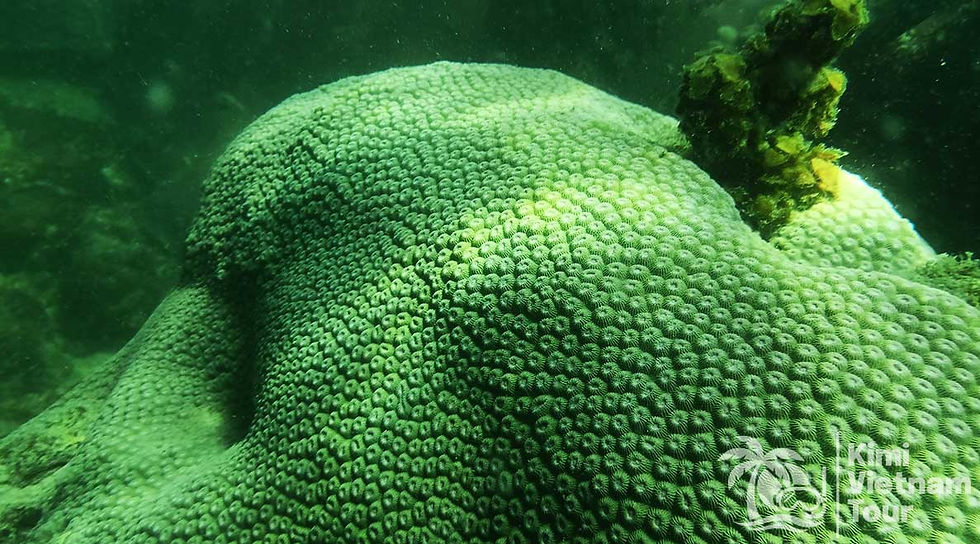
Mushroom Corals (Fungia and related species)Free-living corals that look like discs or plates resting on sandy bottoms between reef structures.

Pavona frondifera A hard coral with thin, wavy, cactus-like plates forming dense colonies on reef rock. Common in tropical Indo-Pacific waters and often provides shelter for small reef fish.

Lettuce Coral (Echinopora lamellosa) A hard coral forming thin, overlapping, leaf-like plates that resemble layers of lettuce. It grows attached to reef rock, creating broad colonies with wavy surfaces. Common in tropical Indo-Pacific reefs, where it provides habitat for small fish and invertebrates.
🌿 Soft Corals
Finger Soft Corals Upright, flexible colonies that move gently with the current, adding motion to the reef.

Leather Corals Thicker, smooth or slightly textured soft corals forming larger colonies in calmer reef sections.
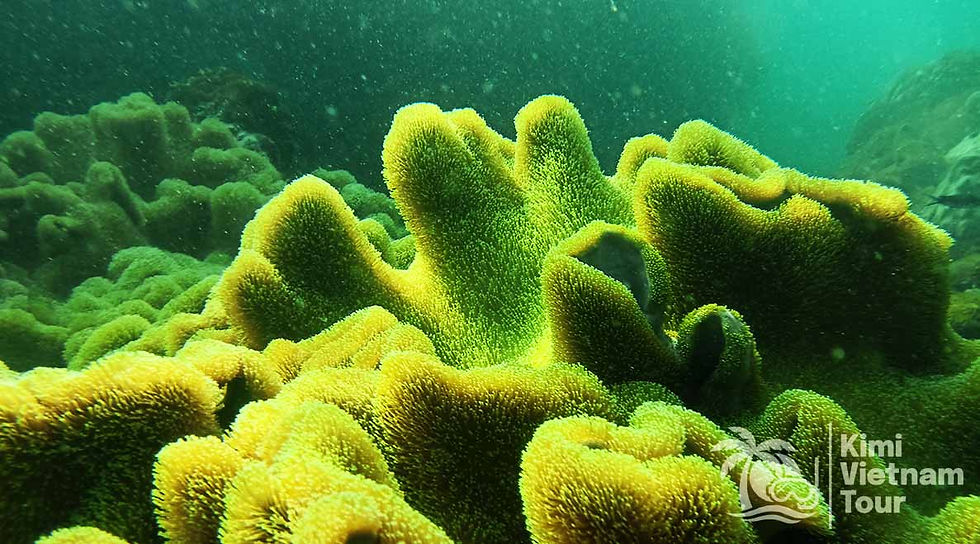
🌺 Sea Anemones
Not corals, but essential reef animals.
Magnificent AnemoneTall and striking with long flowing tentacles — one of the most photogenic underwater sights.

🐠 Fish - Marine Life
Clownfish – living inside sea anemones.

Damselfish & Sergeant Majors – colorful schooling reef fish.

Parrotfish – important reef cleaners that graze on algae.

Butterflyfish & Angelfish – typical indicators of healthy coral systems.

Groupers – larger reef fish hiding in rocky sections.

This is just a small piece of the reef fish diversity living around Phu Quoc — the coral reefs here host about 152 species of reef fish across roughly 71 genera and 31 families.
A healthy reef is easy to recognize: solid hard coral structure, minimal sediment, and diverse fish life.
And the southern islands of Phu Quoc still offer exactly that — if you know where and when to enter the water.
🌅 Morning vs. Afternoon Snorkeling on Phu Quoc

Yes — the water is usually clearer in the morning.But colors underwater are richer in the afternoon, when the sun hits the reef from an angle and everything comes alive.
So:
Morning
better visibility
calmer surface
ideal after rain or wind
Afternoon
stronger colors
more life on the reef
better light for photos
Without the Crowds
🧭 How we do it

On Phu Quoc there is no universal rule.Every day is different — wind, currents, tides.
That’s why we don’t choose the time by the clock, but by the conditions.
And most importantly: we always pick locations so you don’t end up in a crowd of boats.
Want calm water?Want colors?Want the clearest visibility?
We adjust the route and the pace to you.
🤿 Snorkeling with fins or without?
Short answer:Without fins you swim.With fins you actually explore.
Without fins

comfortable, natural
ideal for complete beginners
enough for shallow water and short stops near the beach
but you get tired quickly and won’t go far
👉 good for “watching fish near the shore”
With fins
almost no effort
smooth movement without using your hands
handles current and longer distances
you reach the real reef, not just the edge
less sand stirred up → better visibility
👉 this is where real snorkeling begins
How we do it
On our trips you can always choose either option.But honestly — most people take fins after 5 minutes and never take them off again.
Our instructor always says: without fins you swim a bit like a dog 😄Nobody is forced to wear them.
We only have one rule —if you go without fins, you must use a life vest.Either wear it or keep it under you as a float 🙂
Fins aren’t a sport. They’re your ticket into the underwater world.

🎒 What to bring for snorkeling
Swimwear
A water shirt / rashguard – better sun protection than sunscreen
Towel
Small snack – useful between stops
💧 Drinking water is always available on the boat.
👉 You can bring your own snack, but usually keep it on the boat.On islands with a restaurant, it’s a nice unwritten rule to buy something there and support the locals.
Main causes of bleaching

🌡️ Water temperature (the biggest factor)Just +1 to +2 °C above the long-term average for several weeks → the coral can’t handle photosynthesis → it expels the algae.
☀️ Strong sun & calm water - Without currents the water overheats and UV penetrates deeper — shallow lagoons can suffer more than open sea.
🟤 Turbidity and sediment - Anchors, boats or runoff from land bring sand and silt → the coral suffocates and loses light.
🏗️ Coastal development & pollution - Hotels, harbors and wastewater change water chemistry — nutrients increase, algae grow and slowly overtake the reef.
🧴 Chemicals from sunscreen - Some UV filters damage the symbiotic algae — a rashguard is often better than sunscreen.
⚓ Mechanical damage - Big anchors, stepping on the reef or kicking it with fins can destroy years of growth in seconds.
Why do some reefs survive and others don’t?
Currents make the difference:
current = oxygen, food, cooling
no current = overheating and murky water
That’s why the healthiest reefs are usually on open sides of islands and around rocks, while enclosed bays often collapse first.
👨👩👧👦 Who Should Go Snorkeling on Phu Quoc?

Honestly? Everyone.
You don’t need strong swimming skills or ocean experience.Just curiosity and a calm mind — we adjust everything on the spot.
beginners – we explain and guide you in the water
non-swimmers – with a life vest and supervision it’s comfortable
kids – shallow lagoons are a perfect first contact with the ocean
active travelers – we can take you farther to the real reef
photographers – colors and marine life are never the same twice
Everyone finds their own pace here.Some quietly float above the lagoon, others go for a longer reef loop.
It’s not a sport performance — it’s an experience.
🤿 How to go snorkeling on Phu Quoc

Choose based on how much space and water time you want:
🚤 Private trip – only your group
Best option if you want the real experience.
We adapt the day to the sea, not the clock — spots are chosen by conditions and you stay in the water as long as you like.Guided underwater routes with an instructor, minimum boats, maximum nature.
🌊 Join-in snorkeling – shared boat
Classic group trip with multiple stops and nice reefs.
🏝️ Snorkeling + BBQ island day
Relaxing and swimming — mix of beach, food and snorkel stops.
Want to dive deeper into the diversity and marine life in Phu Quoc? Click here to explore our underwater world.
Simply: want the best underwater world → privatewant to share and save → join-inwant a relaxed sea day → BBQ
On Phu Quoc the sea always decides — and we choose the spots accordingly.

