
Where to Snorkeling in Phu Quoc: Best Coral Reefs, Marine Life & Real Conditions

Updated: Jul 30
The best snorkeling in Phu Quoc is in the south - around the An Thoi Archipelago, where shallow coral reefs, anemone gardens, and calm conditions create the most reliable snorkeling experience on the island.

You step onto the boat and let yourself be taken among the small islands in the south of Phu Quoc. After a few minutes of swimming, you dip your head beneath the surface. Below, a different world opens up – corals, tiny fish, sunlight filtering through the water, and a kind of calm you rarely find on land.
Snorkeling in Phu Quoc isn’t about performance or sport. It’s about discovery. And in this guide, we’ll tell you everything you need to know – where to go, when to go, what you’ll see, and how to prepare.
This article is a complete guide for anyone considering snorkeling in Phu Quoc – whether you’re traveling solo, as a couple, or as a family with children.
In This Guide
Why Snorkeling in Phu Quoc Is Unique

Snorkeling around Phu Quoc has a different character compared to open-ocean destinations. You won’t find deep atolls or dramatic drop-offs plunging into the abyss — instead, it’s a coastal ecosystem rich in detail and vibrant underwater mosaics.
Most snorkeling spots are located at depths between 1 and 6 meters. This makes Phu Quoc an ideal destination for beginners and families with children, while still offering plenty to explore for more experienced snorkelers.
The key to snorkeling in Phu Quoc is the diversity of the seabed. A mix of hard corals, rocky formations, lagoons, and sandy patches creates distinct micro-ecosystems — and each site has its own character, even if they’re just a few minutes apart by boat.
Types of Coral Reefs You’ll Find While Snorkeling in Phu Quoc

Fringing Reefs
Corals grow directly from the rocky shoreline. They begin in shallow water and are easily accessible even without diving equipment.
Patch Reefs – Isolated Coral Outcrops
Standalone coral structures rising from sandy seabeds. They attract larger concentrations of fish, offering shelter and food in an otherwise open environment.
Boulder and Mixed Seabeds
A combination of rocks, hard corals, and soft growth. This varied terrain creates a complex habitat full of hiding spots and small marine life.
What You’ll See Beneath the Surface While Snorkeling in Phu Quoc

The underwater world around Phu Quoc is all about the details. The more calmly you move, the more you’ll notice.
👉Corals of Phu Quoc: Complete Identification Guide with Real Underwater Photos from Phu Quoc
Hard Corals (Scleractinia)
Hard corals form the foundation of the entire reef ecosystem, and their limestone skeletons (CaCO₃) grow over decades to centuries. In the south of the island, you’ll encounter six fascinating forms:
Branching Corals

Typical genera: Acropora, Pocillopora.
Characteristics: They resemble underwater trees or bushes and grow relatively fast.
Why observe them: Their complex branching structure creates hundreds of hiding places for small fish. In the shallow waters around Phu Quoc, they often glow in bright colors. 🌊
Massive and Boulder Corals
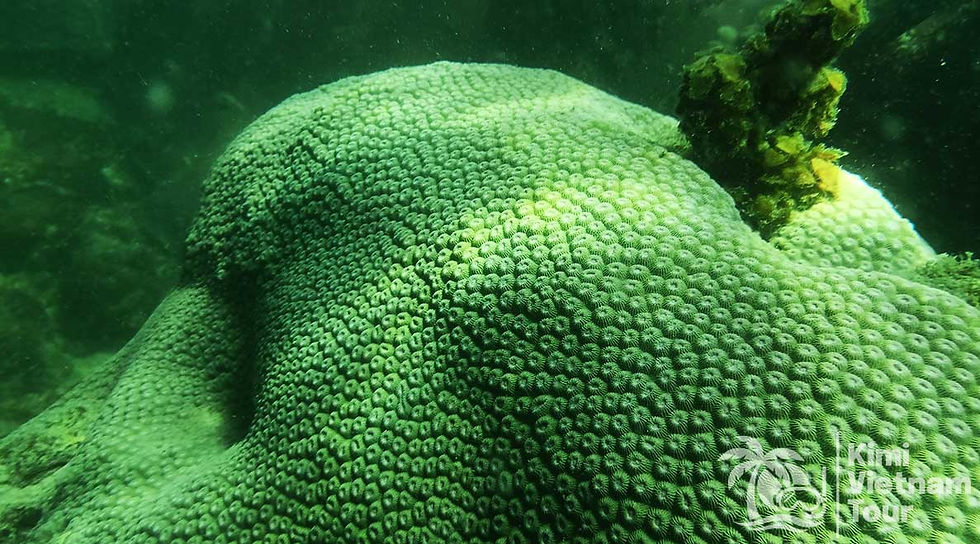
Typical genus: Porites, Diploastrea,
Characteristics: They look like enormous stone mountains or rounded boulders.
Why observe them: They grow very slowly but are incredibly resilient and form the stable foundation of the entire reef. Some of the boulders you can see here may be hundreds of years old. 🪸
Foliose / Plating Corals

Typical genus: Montipora, Echinopora, Pavona.
Characteristics: They form flat plates or wavy “leaves” that maximize surface area to capture sunlight.
Why observe them: They often grow in layers on top of each other, and when viewed from the side they create dramatic underwater silhouettes. 🪸
Cup and Sun Corals (Dendrophylliidae)

Typical genus: Turbinaria, Tubastraea.
Characteristics: Unlike other corals, these often have very large, fleshy polyps that look like "volcanoes" or cups. Turbinaria forms large plates, while Tubastraea grows in bright orange clumps.
Why observe them: They are the "hunters" among corals. You can often see their tentacles extended even during the day, especially on Turbinaria. If you find the orange Tubastraea under a rock, you’ve found one of the most vibrant colors in the Phu Quoc sea. 🪸
Maze Corals

Typical genus: Platygyra, Leptoria.
Characteristics: Their surface is formed by ridges and grooves that closely resemble the structure of a human brain.
Why observe them: They are very solid and compact structures with a striking texture that stands out beautifully in shallow water at depths of about 1–3 meters. 🪸
Brain Corals
Typical genus: Lobophyllia, Oulophyllia.
Characteristics: Their surface is formed by deep valleys and rounded ridges that resemble the structure of a human brain. Colonies are usually massive and fleshy, with large lobes that create a very distinct pattern.
Why observe them: Their large, curved structures and pronounced textures are very easy to recognize while snorkeling. In shallow tropical reefs, especially at depths of about 1–10 meters, they create impressive coral formations that stand out clearly against the reef background. 🪸

Columnar Corals
Typical species on Phu Quoc: Porites cylindrica.
Characteristics: They grow upward, forming short or taller columns.
Why observe them: They are less common, but their distinctive vertical growth immediately catches your attention when swimming over the reef. 🪸
Flowerpot Corals

Typical genus: Goniopora, Alveopora
Characteristics: Their colonies are covered with long, extended polyps that resemble tiny flowers. Each polyp has a circular crown of tentacles that move gently with the current, giving the coral a soft and almost plant-like appearance. When fully expanded, the polyps can completely hide the hard skeleton beneath.
Why observe them: Flowerpot corals are among the most dynamic and visually striking corals on tropical reefs. Their waving “flower-like” polyps create constant movement in the reef landscape, making them very easy to notice while snorkeling, especially in calm shallow waters at depths of about 1–8 meters. 🪸
Mushroom Corals

Typical genus: Fungia, Halomitra, Herpolitha.
Characteristics: Unlike most reef-building corals, mushroom corals usually live as single, free-living individuals rather than large colonies. Their round or elongated bodies resemble mushrooms or flat discs lying directly on the seabed. The surface is covered with radiating ridges that extend from the center toward the edges.
Why observe them: These corals are fascinating because they often rest directly on sand or rubble instead of being attached to the reef. When you spot one while snorkeling, it almost looks like a living fossil lying quietly on the ocean floor. In the shallow reefs around Phu Quoc, they can often be seen in calm sandy areas between coral formations at depths of about 2–10 meters. 🪸
Encrusting corals

Typical genera: Montipora, Echinopora, Leptastrea, Favites, Cyphastrea...
Characteristics: They do not build large branches or domes. Instead, they spread as a thin but very solid layer directly over rocks, reef surfaces, or dead coral skeletons.
Why observe them: These corals act like natural “reef glue.” By tightly covering the surface, they stabilize the reef structure and protect it from erosion while creating habitat for small reef organisms. 🪸
Soft Corals and Gorgonians (Octocorallia): Colors and Movement of the Reef
While hard corals form the solid framework of the reef, soft corals bring life and movement to the underwater world of Phu Quoc. Their key morphological feature is eightfold symmetry — each polyp has exactly eight feather-like tentacles used to capture food.
Because they lack a massive limestone skeleton, their bodies are incredibly flexible, allowing them to sway gracefully with the currents and create a striking contrast with the rigid structures of the reef.
Why are soft corals key to the experience?
Hard corals may be the “bricks” of the reef, but soft corals and gorgonians are what make it feel alive. Thanks to them, snorkeling is never static — the reef responds to every movement of the water, attracting specific fish species and drifting plankton. 🪸🐠🌊
My tip: The combination of both coral forms often determines whether a location feels visually impressive. Even a small reef can become truly unforgettable thanks to soft corals. 🪸🌊
Leather Corals

Typical genus: Sarcophyton.
Characteristics: Massive, smooth colonies resembling mushrooms, caps, or “living cushions.”
Why observe them: During the day they extend their polyps and dominate the shallower parts of the reef. They are the formations that look as if they are gently breathing beneath the surface. 🪸
Tree-Like Soft Corals
Typical genus: Nephthea.
Characteristics: They grow in bush-like forms with delicate branches. Unlike hard corals, they are completely flexible.
Why observe them: They often display beautiful pastel colors and, in gentle currents, appear incredibly dynamic. They are the “dancers” of the reef. 🪸🌊
Finger Soft Corals

Typical genus: Sclerophytum.
Characteristics: Short, thicker “fingers” growing from a single shared base.
Why observe them: They have an irregular growth pattern and are very commonly encountered in the shallow waters around An Thoi. 🪸🌊
Sea Fan (Gorgonians)

Typical genera: Annella, Subergorgia, Melithaea.
Characteristics: Large, fan-shaped soft corals that grow in a single flat plane, usually facing the current. Their flexible branches form intricate net-like patterns supported by a protein skeleton. Unlike branching gorgonians, sea fans spread outward like a natural underwater fan to maximize the surface exposed to flowing water.
Why observe them: Sea fans are among the most photogenic corals on the reef. Their delicate lace-like structure provides shelter for tiny reef creatures such as pygmy seahorses, shrimp, and juvenile fish. As ocean currents move through them, they gently sway, creating one of the most beautiful and peaceful scenes beneath the surface. 🪸🌊
Sea Rod (Gorgonians)

Typical genus: Rumphella.
Characteristics: Branching, rod-like structure rather than a flat fan. Colonies form flexible, elongated branches that gently sway with the current. They have a firm yet bendable internal skeleton, giving them both stability and movement.
Why observe them:They grow in areas with steady water flow, allowing them to filter plankton efficiently. Unlike sea fans, their 3D branching shape creates a more dynamic, almost “underwater forest” feeling. When currents pass through, they come alive with soft, natural motion—making them a unique and calming highlight of the reef. 🪸🌊
Explore detailed coral descriptions, identification tips, and real underwater photos from Phu Quoc.
👉 Corals of Phu Quoc: Complete Identification Guide with Real Underwater Photos from Phu Quoc
Sea Anemones and Clownfish: A Living Home Beneath the Surface 🪸🐠🌊
Sea anemones (Anthozoa) may look like underwater flowers, but don’t be fooled — they are predators. Unlike corals, they do not build a hard skeleton and live as individual animals. Their tentacles are armed with stinging cells called nematocysts, used to capture prey.
Want to dive deeper into the secret life of these stinging beauties?
On the southern reefs of Phu Quoc, you will most often encounter these beautiful species:
Magnificent Sea Anemone (Heteractis magnifica) 🪸🐠

Typical species: Heteractis magnifica
Characteristics: You can recognize it by its strikingly colorful body (often purple, pink, or blue) and long tentacles that constantly sway in the current.
Why observe it: It’s one of the visual highlights of snorkeling. When contracted, it looks like a colorful mound, but when fully expanded it creates a fascinating display in shallow water at depths of 1–8 meters — almost always with a family of clownfish darting among the tentacles.
Carpet Anemone
Typical genus: Stichodactyla
Characteristics: A large, flat body with dense, short tentacles that resembles a colorful disk or a rippling carpet attached to the rock.
Why observe it: It has very powerful stinging cells and is one of the most popular “addresses” for clownfish. In the An Thoi archipelago, these anemones are impossible to miss thanks to their impressive size and rich colors. 🪸🐠🌊
Symbiosis with Clownfish: A Story of Survival

The relationship between clownfish (Amphiprion) and sea anemones is one of the most famous examples of mutualism in the ocean. Clownfish have a special protective mucus on their skin that prevents the anemone from recognizing them as prey, so they are not stung by its tentacles.
What does the clownfish gain?A perfect shelter from predators that are afraid of the anemone’s stinging tentacles.
What does the anemone gain?The clownfish cleans it, chases away intrusive fish, and its constant movement helps improve water circulation and oxygen flow around the tentacles. 🐠🪸🌊
Kimi Vietnam Tour insight: Not every anemone has its own clownfish. It’s exactly these tiny “micro-stories,” happening within just a few square centimeters, that turn snorkeling into an experience that makes you stop and simply watch.
The quality of a reef isn’t measured in kilometers — it’s measured in these living details that you can observe up close in our waters. 🐠🪸🌊
Reef Fish You Can See While Snorkeling in Phu Quoc
The reefs around Phu Quoc are full of movement and color. The moment you put your head under the water, you’ll notice fish weaving between corals, small groups patrolling the reef edge, and curious individuals watching from their coral shelters. 🐠🌊
The warm waters of the Gulf of Thailand host many typical tropical reef species that are easy to spot even while snorkeling in shallow water.
Parrotfish (Scaridae)

Genera: Scarus, Chlorurus
Common species: Scarus ghobban
How often seen: Common
Typical habitat: Shallow coral gardens and reef flats
Parrotfish are among the most important reef fish in southern Phu Quoc. They are often seen grazing on coral surfaces, helping control algae growth and contributing to the formation of fine tropical white sand.
Butterflyfish (Chaetodontidae)

Genera: Chaetodon, Heniochus
Common species: Chelmon rostratus
How often seen: Common
Typical habitat: Coral heads and healthy reef slopes
Butterflyfish are elegant reef inhabitants with striking patterns, frequently observed swimming in pairs around living coral formations.
Damselfish (Pomacentridae)

Genera: Chromis, Dascyllus, Abudefduf
Common species: Abudefduf vaigiensis
How often seen: Very common
Typical habitat: Branching coral areas and shallow reef zones
Damselfish are small but highly active reef fish constantly moving among coral branches where they defend tiny territories.
Clownfish / Anemonefish (Pomacentridae)

Genus: Amphiprion
Common species: Amphiprion perideraion
How often seen: Common
Typical habitat: Sea anemone gardens in sheltered reef areas
Clownfish live in symbiosis with sea anemones, forming one of the most fascinating and beginner-friendly reef encounters.
Wrasses (Labridae)

Genera: Thalassoma, Halichoeres, Cheilinus
Common species: Thalassoma lunare
How often seen: Common
Typical habitat: Reef edges and mixed coral formations
Wrasses are energetic swimmers often seen darting quickly between coral structures while searching for small prey.
Groupers (Serranidae)

Genera: Epinephelus, Cephalopholis, Plectropomus
Common species: Epinephelus merra
How often seen: Occasional
Typical habitat: Coral caves, rocky crevices and reef drop-offs
Groupers are powerful reef predators usually resting in shaded areas before slowly emerging to observe passing snorkelers.
Surgeonfish (Acanthuridae)

Genera: Acanthurus, Zebrasoma, Ctenochaetus
Common species: Acanthurus triostegus
How often seen: Common
Typical habitat: Reef slopes and outer reef zones
Surgeonfish are fast-moving herbivores frequently encountered grazing along coral reef edges.
Rabbitfish (Siganidae)

Genus: Siganus
Common species: Siganus guttatus
How often seen: Common
Typical habitat: Lagoon reefs and seagrass-rich coastal areas
Rabbitfish are peaceful schooling fish often seen feeding on algae and seaweed in calm shallow environments.
Fusiliers (Caesionidae)

Genera: Caesio, Pterocaesio
Common species: Caesio cuning
How often seen: Common
Typical habitat: Open water above coral reefs
Fusiliers form large shimmering schools that create dynamic underwater scenes while moving along reef slopes.
Batfish / Spadefish (Ephippidae)

Genus: Platax
Common species: Platax teira
How often seen: Occasional
Typical habitat: Sandy reef edges and deeper lagoon zones
Batfish are large slow-moving fish often approaching snorkelers with calm curiosity.
Cardinalfish (Apogonidae)

Genera: Apogon, Ostorhinchus, Cheilodipterus
Common species: Cheilodipterus quinquelineatus
How often seen: Common
Typical habitat: Shaded coral overhangs and narrow reef passages
Cardinalfish are small secretive fish usually hiding in groups within protected reef structures.
Jacks / Trevallies (Carangidae)

Genera: Caranx, Carangoides, Gnathanodon
Common species: Caranx sexfasciatus
How often seen: Occasional
Typical habitat: Reef drop-offs and open blue water
These fast predators sometimes appear suddenly in hunting formations creating exciting snorkeling moments.
Goatfish (Mullidae)

Genera: Mulloidichthys, Parupeneus, Upeneus
Common species: Parupeneus barberinus
How often seen: Common
Typical habitat: Sandy patches between coral reefs
Goatfish use sensitive barbels to search for small invertebrates hidden in the sand.
Snappers (Lutjanidae)

Genera: Lutjanus, Pinjalo, Aprion
Common species: Lutjanus fulviflamma
How often seen: Occasional
Typical habitat: Coral slopes and rocky reef structures
Snappers are alert mid-level predators often seen moving in loose groups near reef formations.
Moray eels (Muraenidae)

Genera: Gymnothorax, Echidna
Common species: Gymnothorax javanicus
How often seen: Occasional
Typical habitat: Coral holes, caves and reef crevices
Moray eels are impressive but usually shy hunters that watch the surroundings from their hidden reef shelters.
"This list shows only a small selection of fish that can be observed during normal everyday snorkeling trips around southern Phu Quoc. The island’s coral reefs are home to an impressive marine biodiversity — scientists estimate that approximately 120–160 species of reef fish inhabit these waters. Creating a complete list of all fish species found around the island would require hundreds of pages and could easily fill an entire book. Every snorkeling trip is therefore unique, and you never know what colorful reef inhabitants you may discover next. 🐟✨"
These fish form the living, colorful layer of the reef ecosystem around Phu Quoc, where every snorkeling trip reveals new movements, patterns, and interactions within the coral world. 🐟🪸
Why large fish are less common here
The coastal reefs around Phu Quoc lie in the warm, relatively shallow waters of the Gulf of Thailand. These conditions are ideal for coral growth and for many smaller reef fish species that live directly within the coral structures.
At the same time, warm and shallow reef environments typically support fewer large predatory fish. Larger species usually prefer deeper water, outer reef slopes, or areas with stronger ocean currents where food availability and hunting conditions are better.
Because of this, snorkeling reefs are often dominated by smaller, colorful reef fish that spend their entire lives among the corals. While large fish appear occasionally, the real richness of these reefs lies in their diversity of smaller species and the constant movement they bring to the underwater world. 🐠🪸
Other Reef Residents

Coral reefs are not home only to fish. Many fascinating creatures live directly on the reef surface, hide between corals, or move slowly across the seabed. While snorkeling around Phu Quoc, you may also encounter a variety of invertebrates and other reef animals that play an important role in the reef ecosystem. 🪸
Common reef creatures you may see
Sea star – including colorful species sometimes resting on sandy patches or coral rubble.
Sea urchin – spiny reef grazers often hiding between rocks and corals.
Sea cucumber – slow-moving cleaners of the reef floor that feed on organic material in the sand.
Crabs – many small species living between corals or inside reef crevices.
Octopus – intelligent masters of camouflage that hide among rocks and coral rubble.
Sponges – colorful filter feeders growing on rocks and coral surfaces.
Sea anemones – soft-bodied animals whose tentacles host clownfish and other small reef species.
Snorkeling around Phu Quoc reveals a diverse coral reef ecosystem where fish, sea stars, crabs, sea urchins, and many other marine creatures live closely connected. Even in shallow water, this fragile environment supports a surprising variety of life in the warm waters of the Gulf of Thailand. 🪸🐠
Coral reefs grow slowly and depend on stable conditions, which is why they deserve a careful and respectful approach from every visitor exploring them while snorkeling. 🌊

Coral Reefs of the An Thoi Archipelago
The coral reefs around the An Thoi Archipelago in southern Phu Quoc belong to the tropical reef ecosystems of the Gulf of Thailand.
These reefs are typically shallow coral gardens where hard corals such as brain corals, branching corals and plate corals grow together with soft corals and sea fans.
Most snorkeling areas lie in depths between 1–6 meters, which allows sunlight to reach the reef and supports a rich ecosystem of reef fish, anemones, and invertebrates.
Because the islands of the An Thoi Archipelago protect many bays from open sea waves, some locations offer surprisingly calm snorkeling conditions even for beginners.
Ready for the ultimate underwater adventure?
Check out our quick snorkeling guide in Phu Quoc and see what’s waiting below the surface.
Best Snorkeling Locations in the An Thoi Archipelago
The best snorkeling around Phu Quoc takes place in the southern island group known as the
An Thoi Archipelago. These small tropical islands offer shallow coral reefs, clear water, and diverse marine life that can be explored easily while snorkeling. 🪸🐠
We carefully choose snorkeling spots that offer the best chances to observe a wide variety of underwater life. Coral structures, reef fish, and sea anemones are common highlights — and anemones with their resident clownfish are almost always guaranteed. 🌊
Location of Coral Reefs in the An Thoi Archipelago - Snorkeling in Phu Quoc
This map highlights 13 main snorkeling locations in the southern islands of Phu Quoc that we carefully select based on sea conditions, water visibility, and reef biodiversity. In addition to these primary sites, we also explore many smaller and less-known coral areas chosen on the day of each trip to provide the best possible underwater experience. Every reef has its own coral formations, fish life, and natural character, making each snorkeling trip in the An Thoi Archipelago truly unique. 🌊🐠🌴
Hòn Thơm, Hòn Rỏi, Hòn Dừa, Hòn Dăm Trong, Hòn Dăm Ngoài, Hòn Mây Rút Trong, Hòn Mây Rút Ngoài, Hòn Móng Tay, Hòn Gầm Ghì, Hòn Bườm, Hòn Kim Quy.

Snorkeling map legend:
Hòn Kim Quy
Hòn Mây Rút Ngoài
Hòn Khô
Hòn Trắng
Hòn Mây Rút Trong
Hòn Gầm Ghì
Hòn Bườm
Hòn Móng Tay
Hòn Vàng
Hòn Thơm
Hòn Rỏi
Hòn Dừa
Hòn Dăm Ngoài & Hòn Dăm Trong
Hon Kim Quy – For More Experienced Snorkelers
Hon Kim Quy offers one of the most interesting underwater landscapes in the area. The seabed is rugged and full of rocky formations, passages, and small reef caves that create shelter for many reef species. It’s a great location for snorkelers who enjoy exploring more complex reef terrain.
Typical sightings: mixed coral communities, large sea anemones with clownfish, wrasses, butterflyfish, groupers hiding in crevices, parrotfish grazing on coral, batfish moving slowly above the reef.

Hon Vang – A Quiet Tropical Bay
Hon Vang is a peaceful snorkeling location with relatively stable conditions and fewer visitors. The reef here forms a natural underwater landscape where coral structures and reef fish can be observed in a calm tropical setting.
Typical sightings: mixed coral communities, butterflyfish, parrotfish, damselfish, reef crabs, sea urchins.

May Rut Trong – Perfect for First-Time Snorkelers
May Rut Trong is one of the most beginner-friendly snorkeling locations in the area. The lagoon is shallow, calm, and protected, with a gentle sandy entry that makes it ideal for guests experiencing snorkeling for the first time.
Typical sightings: mixed coral communities, damselfish, small wrasses, sea stars, sea cucumbers.

May Rut Ngoai – Natural Reef Gradient
The seabed around May Rut Ngoai gradually transitions from shallow coastal areas into deeper reef slopes and rocky formations. This natural change in depth creates a diverse habitat that can be enjoyed by both beginners and more confident snorkelers.
Typical sightings: mixed coral communities, parrotfish, wrasses, butterflyfish, reef fish along rocky slopes.

Hon Mong Tay – Snorkeling and Beach Time
Hon Mong Tay combines relaxed snorkeling with a beautiful tropical island atmosphere. The surrounding reefs host a diverse reef community, while the island itself offers white sand beaches and calm turquoise lagoons where visitors can relax between snorkeling sessions.
Typical sightings: mixed coral communities, sea anemones with clownfish, parrotfish, groupers, butterflyfish, damselfish, sea urchins, reef crabs.

Hon Buom – The Most Versatile Snorkeling Location
Calm water, excellent visibility, and a varied seabed with coral formations and natural swim-through passages make Hon Buom one of the most balanced snorkeling spots in southern Phu Quoc. Access from the boat is easy, and the reef structure offers something for both beginners and experienced snorkelers.
Typical sightings: mixed coral communities, sea anemones with clownfish, damselfish, wrasses, parrotfish, small reef crabs.

Hon Gam Ghi – Shallow Reefs and Underwater Rock Formations
Hon Gam Ghi is known for its calm turquoise water and accessible shallow reefs, making it attractive for beginners. At the same time, the island also offers more complex underwater rock formations and passages that experienced snorkelers can explore in selected areas.
Typical sightings: mixed coral communities, sea anemones with clownfish, damselfish, wrasses, reef crabs, sea urchins.

Hon Kho – Remote Reef for Confident Snorkelers
Hon Kho is a small rocky island rising directly from the open sea. Because it is rarely visited, the surrounding waters often feel wild and untouched. The reef edges here attract larger reef fish, making it a rewarding location for confident snorkelers who enjoy observing marine life in quieter surroundings.
Typical sightings: mixed coral communities, larger reef fish including groupers, larger wrasses, parrotfish, and occasionally bamboo sharks resting near the reef.

Hon Dam Ngoai – Calm Lagoon Snorkeling
Hon Dam Ngoai offers relaxed snorkeling in shallow lagoons with clear water and gentle seabed conditions. The calm environment makes it suitable for all experience levels and allows visitors to observe reef life at a comfortable pace.
Typical sightings: mixed coral communities, sea anemones, damselfish, cardinalfish, sea stars, small reef fish.
Together, these islands form one of the most diverse snorkeling areas around Phu Quoc. Each location offers slightly different reef structures and marine life, which is why we always select the best spots based on sea conditions and visibility on the day of the trip. 🌊🐠
2026 news info Hon Thom
🤿 Is Snorkeling Around Hon Thom Worth It in 2026?
Snorkeling around Hon Thom is possible, but it’s not where you’ll find the best conditions on Phu Quoc.
With ongoing development and busy boat traffic, water clarity and coral quality near the island can vary a lot. It’s fine for a quick dip, but if you’re expecting vibrant reefs and rich marine life, this isn’t the top spot anymore.
👉 Planning your visit to the island itself?
Best Time for Snorkeling in Phu Quoc

Snorkeling conditions around Phu Quoc change throughout the year. What matters most is not only the season but also the current wind, sea conditions, and choosing the right snorkeling location.
Dry Season (November – April)
This is generally the most stable part of the year. The sea is usually calmer, rainfall is lower, and underwater visibility is often good (typically 5–15 meters).
Snorkeling conditions are more predictable during this period, which makes it a great choice for visitors who prefer stable weather and calmer seas.
Transition Periods
During the seasonal transitions, conditions can change more quickly. However, these weeks often come with fewer tourists and surprisingly good underwater visibility of around 5–10 meters.
Some days can even be calmer than parts of the dry season.
Rainy Season (May – October)
The rainy season is often underestimated. There are days with stronger wind and reduced visibility (3–5 meters), but calm periods regularly appear between weather systems.
During these stable windows, the sea can become very calm and underwater visibility can improve significantly, often reaching 3–10 meters.
What really matters is not the season itself, but the actual sea conditions on a given day.
Water Temperature
Sea temperature stays warm throughout the entire year, usually between
27–30 °C (81–86 °F).
A wetsuit is not necessary — most people snorkel comfortably in a swimsuit and a light rash guard.
Local guides who know the reefs of southern Phu Quoc always select snorkeling locations based on the current sea conditions, wind direction, and visibility to ensure the best possible experience on that particular day. 🌊🐠
Snorkeling with Kimi Vietnam Tours – What Makes the Experience Different
Snorkeling is not just about floating on the surface and looking down at rocks. Once you know what you are seeing, the reef suddenly becomes a living world.
That’s why we take a few minutes on the boat to introduce the basics of the reef. You’ll learn how to recognize some of the most common corals, sea anemones, and reef fish you will see underwater. Nothing complicated — just simple explanations so that when you put your head under the water, the reef actually starts to make sense.

"Think of it as a small underwater expedition," we often say on the boat. "Once you know what to look for, snorkeling becomes much more exciting. Suddenly you’re not just looking at rocks — you’re discovering a living reef."
Instead of anonymous shapes on the seabed, you’ll begin to notice coral colonies, anemone gardens with clownfish, grazing parrotfish, and the small details that make coral reefs one of the most diverse ecosystems on the planet.
The first snorkeling stop is usually chosen for calm water and easy conditions. It’s the perfect place to get comfortable in the water and start exploring the reef at your own pace.
After a short break on the boat with fresh fruit and coconut, we continue to another snorkeling location — selected for diversity and interesting reef structures rather than just for size.
Every reef is different. Some places offer coral gardens, others rocky formations, small swim-through passages, or sandy areas where different species gather. Exploring these environments is what makes the day interesting.
The trip usually finishes at a tropical island beach with a small bar or restaurant. Shade, calm water, and time to relax before we slowly return back to the harbor.

The goal is simple: to spend a day at sea and experience a real living coral reef — not just look at the ocean from above.
A Few Simple Snorkeling Tips
To keep the reef healthy and enjoyable for everyone, we follow a few simple rules:
Do not stand on coral — coral is alive and grows very slowly
Keep a respectful distance from marine life
Move calmly in the water and avoid sudden movements
Use reef-safe sunscreen whenever possible
Take your time and simply observe
Coral reefs are fragile ecosystems, but when treated with respect they can be incredibly rewarding to explore.
And once you start recognizing what you see underwater, snorkeling becomes something very different — not just swimming above the reef, but actually discovering it. 🪸🐠🌊

Eco Snorkeling vs. Island Hopping
On Phu Quoc you will often hear about the popular “3 Island Hopping” tours. It’s a common way to quickly visit several islands and take photos on different beaches.
At Kimi Vietnam Tours, we chose a different approach — the Eco Snorkeling Tour.
Slow pace — Our goal is not to collect the number of islands visited, but the depth of the experience. We spend as much time on the reef as the sea conditions and your curiosity allow.
Silence below the surface — We look for places where you can calmly listen to the sound of the ocean and even the quiet crunching of parrotfish feeding on the reef. The goal is to experience the peaceful atmosphere that brought you to the ocean in the first place.
Respect for the ecosystem — We are not just observers, we are guests. Our guests learn how to notice the details of the reef and move through the water in a way that leaves the underwater world untouched for those who come after us.
Morning flexibility — The sea is different every day. Our routes are not fixed on paper but chosen according to the current conditions. We go where the water is clearest and the sea calmest that day.
👉 3 Island Hopping or Snorkeling Tour on Phu Quoc? All boats go to the same islands — so why is every trip completely different?
" Tomáš’s perspective — For us, snorkeling is not just another activity in the itinerary. It is the heart of the experience. It’s the moment when time slows down and you suddenly become part of a completely different world. 🪸🌊🐠 "

Snorkeling Safety and Respect for Coral Reefs in Phu Quoc
The ocean is not a swimming pool. But it’s also not something to fear. A few simple rules help keep the experience safe and enjoyable for everyone.
We explain the conditions before entering the waterBefore every snorkeling stop we briefly explain the sea conditions, the reef structure, and how we will move in the water.
Stay close to the groupThe reef is more enjoyable when explored together. Please avoid swimming out toward the open sea and stay within the area where the guide and boat are nearby.
Do not stand on coralCoral reefs are living organisms and grow very slowly. Many coral structures and shells are extremely sharp, sometimes as sharp as a razor blade. Stepping on them can easily cause deep cuts. The best way to explore the reef is to float calmly above it.
Move slowly and calmly in the waterSlow movement means more fish around you and a much more natural snorkeling experience.
Use your fins instead of your handsMove slowly and swim using your fins rather than your arms. This saves energy, helps you stay relaxed in the water, and allows us to explore a larger part of the reef together. Everything is explained on the boat before we enter the water.
Life jackets are always availableLife jackets are carried on the boat and ready for use in the water. If you prefer not to use fins, a life jacket is provided — no discussion.
We only go out when conditions are safeSea conditions change every day. Snorkeling trips take place only when the weather and sea state allow safe exploration of the reef.
👉 Want to understand snorkeling safety in detail?
➡️ Read our full guide: Snorkeling Safety in Phu Quoc
" And one more thing worth remembering:
Some coral colonies around Phu Quoc may be decades old. Moving calmly underwater is not only about having a better experience — it also helps keep the reef alive for the people who will come after us. 🪸🌊🐠 "

Who Snorkeling in Phu Quoc Is For
Snorkeling is not about performance. It’s about the experience. And it’s for more people than you might think.
It’s perfect for you if:
You want to experience the ocean beyond the beach - Snorkeling lets you discover the world just below the surface — something you simply can’t see from the shore.
You are traveling as a couple and looking for a shared experience - Exploring a coral reef together creates memories that are very different from typical beach activities.
You are a family with children and want a safe, interesting activity - In calm conditions, snorkeling can be a fascinating and accessible adventure for kids as well.
You enjoy nature and the living world underwater - Coral reefs are full of small details — fish, coral structures, and tiny movements of life everywhere around you.
You are an active traveler and don’t want to spend the whole day by the pool - Snorkeling offers a perfect balance of exploration, relaxation, and time in the ocean.
You are not a strong swimmer - That’s completely fine. We choose snorkeling locations according to the sea conditions and your experience level. Even non-swimmers can comfortably enjoy the richness of underwater life and become part of the reef world.
All you need is a basic level of comfort in the water. The rest we will figure out together.
Snorkeling around the An Thoi Islands in southern Phu Quoc is about calm movement, observing details, and enjoying the ocean at a slower pace.
It’s a day when you slow down — and often end up experiencing far more than you expected. 🪸🌊🐠

Frequently Asked Questions – FAQ
Do I need to know how to swim?
You don’t have to be a strong swimmer. Basic comfort in the water is enough — meaning you are not afraid of the sea and can stay relaxed on the surface.
Life jackets are always available, and no one is trying to prove anything here. We adjust the pace to each guest so everyone can enjoy the experience comfortably.
Is the trip suitable for children?
Yes — for children of almost any age. We have the equipment and the experience to make the trip comfortable for families.
If a child prefers to stay on the boat or parents want to remain nearby, that’s not a problem. Our guide stays on the boat while the snorkeling instructor goes into the water with guests, so everyone always knows who is where.
How long does the trip take?
A join-in snorkeling trip usually takes around 4 - 5 hours.
A private tour can be the same length or longer depending on the group and what you would like to experience during the day.
We usually depart at two different times:
Morning trip around 8:00 AM
Afternoon trip around 1:00 PM
We also offer an afternoon snorkeling trip with beach BBQ at sunset, which also starts around 1:00 PM with hotel pickup.
What if the weather is bad?
The ocean cannot be controlled — but it can be understood.
We check the weather forecast and the actual sea conditions every day. Trips only depart when the conditions are safe and suitable for snorkeling.
If the sea conditions are not appropriate, the trip will simply not take place.
What should I bring with me?
Bring swimwear, a towel, and sunscreen — ideally reef-safe sunscreen that protects both your skin and the coral reef.
All snorkeling equipment is included in the trip:
mask
snorkel
fins
life jacket
We also have fresh fruit and coconut on the boat, and the final stop is usually at a beach with a bar or small restaurant where you can buy food or drinks if you like.

Snorkeling in Phu Quoc with Kimi Vietnam Tours
Private Snorkeling Tour - A boat just for you, your family, or your friends. The itinerary is flexible and adjusted to your pace and the sea conditions that morning.
Join-In Snorkeling Tour - Join a small group of like-minded travelers and explore some of the best snorkeling locations in the An Thoi Archipelago together.
Snorkeling with Beach BBQ - A combination of exploring the underwater world and relaxing on a tropical beach, finished with fresh food prepared right on the sand in one of our favorite bays.
Private Snorkeling & Beach BBQ Tour – A fully personalized sea adventure with your own private boat, professional guide and flexible itinerary. Discover colorful coral reefs, swim in crystal-clear tropical waters and escape to peaceful island beaches. The experience is finished with a relaxed beach BBQ prepared exclusively for you in a beautiful hidden bay.
Kimi Vietnam Tour — Snorkeling around the An Thoi Islands is not just a tour — it’s a chance to discover one of the most fascinating underwater ecosystems in southern Vietnam, even if you have never snorkeled before. 🪸🌊🐠
2026 Snorkeling Update: Our Top Pick Locations

Kim Quy Coral Reef in 2026
The absolute biodiversity winner of the 2026 season. After the challenging El Niño years, the reef has caught its "second breath" and is now in peak condition. Expect expansive coral gardens with lush, massive colonies of Heteractis magnifica sea anemones hosting countless clownfish, vast fields of Pavona leaf corals, and giant Acropora tables. The overall species composition is incredibly diverse-ranging from massive Sarcophyton leather coral colonies to stunning Turbinaria cup corals. It is a thriving underwater metropolis teeming with fish and visibility consistently holding above 8 meters.
Hon Buom Coral Reef in 2026
Hon Buom 2026: Our most versatile location for 2026, perfectly accessible in all weather conditions, even for absolute beginners. This reef is a visual feast: vibrant Goniopora (flowerpot coral) gardens, massive sea anemones with clownfish, and endless fields of Echinopora lamellosa plating corals. You can explore underwater canyons literally carpeted with living Fungia mushroom corals and swim past giant Diploastrea heliopora boulders that are hundreds of years old. Currently, the area is full of schools of Damselfish, with frequent sightings of Parrotfish.
Kimi Vietnam Tour • Phu Quoc, Vietnam • Tomáš Komrska • The content of this article may only be used with the author’s permission.


