
Corals of Phu Quoc: Complete Coral Identification Guide
Updated: Aug 19

Snorkeling in Phu Quoc: Discover the Coral Reefs Below
Discover the coral reefs of Phu Quoc with our complete coral identification guide. Learn how to recognize hard corals, soft corals, sea fans, and other reef species found while snorkeling in the An Thoi Archipelago.
Coral reefs are the living foundation of Phu Quoc's underwater world. While snorkeling around the islands of the An Thoi Archipelago, you'll encounter an incredible diversity of reef-building corals - from giant centuries-old boulder corals and delicate branching Acropora to colorful flowerpot corals, soft leather corals, and graceful sea fans.
This guide is designed to help you identify the corals you see beneath the surface, understand how they grow, and learn where they are most commonly found around Phu Quoc. Every coral profile includes identification tips, habitat, depth, and interesting facts based on our own observations while exploring the reefs of southern Phu Quoc.
Whether you're snorkeling for the first time, photographing marine life, or simply curious about the reef below your fins, this growing coral atlas will help you discover one of Vietnam's richest tropical marine ecosystems.
Quick Facts
Guide Type | Complete Coral Identification Guide |
Region | An Thoi Archipelago, Phu Quoc, Vietnam |
Coral Groups | Hard Corals, Soft Corals & Gorgonians |
Field Documentation | All corals were photographed or documented during real snorkeling expeditions around Phu Quoc. |
Best Activities | Snorkeling, Eco Snorkeling & Scuba Diving |
Typical Depth | 1–15 m (3–49 ft) |
Difficulty | Beginner Friendly |
Last Updated | July 24, 2026 |
This is a living coral atlas, not a static article. Every coral featured in this guide was photographed or carefully documented during real snorkeling expeditions around the An Thoi Archipelago in southern Phu Quoc. Every underwater photograph in this guide is an original image captured by Kimi Vietnam Tour during real snorkeling expeditions and remains the exclusive property of Kimi Vietnam Tour. As we continue exploring new reefs, documenting additional coral species, and improving our underwater photography, this guide will continue to grow with new species profiles, photographs, and field observations.
Why Phu Quoc Is More Than a Tropical Island
Every year, millions of travelers visit Phu Quoc for its white-sand beaches, turquoise water, and tropical resorts. But beneath the surface lies another world that many visitors never discover - a living coral reef ecosystem stretching across the sheltered islands of the An Thoi Archipelago.
🪸 One of Vietnam's richest coral ecosystems
The reefs surrounding the An Thoi Archipelago are among the most diverse shallow-water coral ecosystems in Vietnam, supporting an extraordinary variety of reef-building corals and marine life.
🌊 Perfect conditions for snorkeling
Unlike destinations dominated by deep reef walls, many of Phu Quoc's coral gardens begin in shallow water between 1 and 6 meters (3–20 ft), making them easily accessible for snorkelers of all experience levels. Healthy coral communities extend to 18 meters (59 ft) and beyond, offering even more diverse underwater landscapes for experienced freedivers and scuba divers.
🐠 A home for hundreds of marine species
These coral reefs provide habitat for colorful reef fish, sea anemones, crustaceans, mollusks, echinoderms, nudibranchs, and countless smaller organisms that depend on healthy coral colonies to survive.
🏝️ Protected by the An Thoi Archipelago
The surrounding islands reduce wave energy and create calm, sunlit waters where coral reefs can thrive and continue growing year after year.
🌍 Small in size, enormous in importance
Although coral reefs cover less than 1% of the world's ocean floor, they support approximately 25% of all known marine species, making them one of the most important ecosystems on Earth.
Learning to recognize corals transforms snorkeling from simply admiring colorful underwater scenery into understanding the living ecosystem beneath the surface. Every coral colony tells a story - how it grows, how it survives, and how it supports the incredible diversity of life that makes Phu Quoc one of Vietnam's most fascinating snorkeling destinations.
What Is a Coral?
Despite their appearance, corals are not plants or rocks-they are living animals. Each coral colony is made up of thousands of tiny animals called polyps, which work together to build the limestone skeleton that forms coral reefs over hundreds or even thousands of years.
Coral reefs are among the most important ecosystems on Earth, providing shelter, food, and breeding grounds for countless marine species while protecting coastlines from waves and erosion.
🪸 Kingdom
Animalia (Corals are animals, not plants.)
🔬 Group
Cnidaria (the same animal group as sea anemones and jellyfish)
🐙 Built by
Thousands of tiny animals called polyps, living together as a single colony.
🪨 Skeleton
Most reef-building corals produce a hard calcium carbonate (limestone) skeleton that forms the foundation of coral reefs.
🌿 Two Types of Corals
Zooxanthellate corals - contain microscopic symbiotic algae (zooxanthellae) that provide most of their energy through photosynthesis. These corals require sunlight and build the vast majority of tropical coral reefs.
Azooxanthellate corals - do not contain symbiotic algae and obtain all of their food by capturing plankton and organic particles from the water. They are less common on shallow tropical reefs and are often found in deeper or shaded habitats.
🌡️ Preferred Water Temperature
Most reef-building corals found around Phu Quoc thrive in water temperatures of approximately 23–29°C (77–84°F). Short periods outside this range are usually tolerated, but prolonged exposure to temperatures above 30–31°C (86–88°F) can place corals under severe stress.
⚠️ Coral Bleaching
When seawater remains unusually warm for extended periods, corals may expel the microscopic algae (zooxanthellae) living within their tissues. This causes the coral to turn white - a process known as coral bleaching.
If temperatures return to normal quickly, many corals can recover. However, prolonged or repeated heat stress may lead to partial or complete colony death, especially when combined with other environmental pressures.
🌍 Major Threats to Coral Reefs
The most serious threats affect entire reef ecosystems and can damage coral communities over many square kilometers.
🌡️ Marine heatwaves and climate change – prolonged periods of unusually warm seawater are the leading cause of mass coral bleaching worldwide.
🏗️ Unsustainable coastal development, dredging, and land reclamation – can permanently alter reef habitats, increase sedimentation, and reduce water clarity.
🚰 Untreated wastewater and nutrient pollution – poor sewage treatment and runoff degrade water quality, promote algal growth, and weaken coral resilience.
🌧️ Sedimentation from construction and land clearing – fine sediments settle on corals, reducing light and forcing colonies to spend energy removing accumulated particles.
⚠️ Additional Local Threats
Although usually more localized, these pressures can still damage reefs and should never be ignored.
⚓ Careless anchoring and poorly installed mooring lines.
🏊 Standing on, touching, or breaking corals while snorkeling or diving.
🛥️ Boat groundings and propeller damage.
⛽ Fuel, oils, and cleaning chemicals released into the sea.
🧴 Excessive use of certain sunscreen ingredients in heavily visited areas.
🗑️ Marine litter and abandoned fishing gear that can cause localized physical damage.
⏳ Growth Rate
Most hard corals grow between 0.5–10 cm (0.2–4 in) per year, depending on the species. Fast-growing branching corals such as Acropora may grow several times faster than massive corals like Porites or Diploastrea, which often require centuries to reach their impressive size.
🐠 Importance
Although coral reefs cover less than 0.1% of the ocean floor, they provide habitat for approximately 25% of all known marine species, making them one of the most biodiverse ecosystems on Earth.
💡 Did You Know? The Big Momma Porites coral in American Samoa is considered one of the oldest known living corals on shallow tropical reefs, with an estimated age of more than 500 years.Massive corals grow extremely slowly, so what appears to be an ordinary coral colony may have started growing centuries before many of today's cities even existed. That's why responsible snorkeling, without touching or standing on corals, is essential for protecting these remarkable marine ecosystems.
🌿 Why Eco-Friendly Tours Matter
Coral reefs take decades, centuries, or even thousands of years to grow, yet they can be damaged or destroyed in a single day. Responsible eco-friendly tours play an important role in reef conservation by educating visitors, promoting responsible snorkeling practices, and minimizing human impact on fragile marine ecosystems. Simple actions, such as looking without touching, maintaining good buoyancy, avoiding contact with corals, and respecting marine life, help protect these reefs for future generations.
Every responsible snorkeling trip helps ensure that future generations can experience the same healthy coral reefs we enjoy today.
📚 Coral Index
🪸 Hard Corals:
Acropora • Porites • Pavona • Echinopora • Diploastrea • Platygyra • Lobophyllia • Goniopora • Pocillopora • Fungia • Tubastraea • Plerogyra • Galaxea • Turbinaria
🌿 Soft Corals:
🌊 Gorgonians:
Acropora Coral
Acropora coral with Kim Quy Reef in the background
Scientific Name | Acropora spp. |
Coral Type | Hard Coral (Scleractinia) |
Family | Acroporidae |
Growth Form | Branching, Table, Bottlebrush |
Typical Growth Forms in Phu Quoc | Table Acropora, Staghorn Acropora |
Typical Colors | Cream, Brown, Neon Green, Blue, Purple |
Common in Phu Quoc | ⭐⭐⭐⭐⭐ Very Common |
Typical Depth in Phu Quoc | 1–8 m (3–26 ft) |
Best Season | Year-round (best visibility during the dry season) |
Growth Rate | 10–20 cm (4–8 in) per year |
Ecological Role | Major reef builder, creating habitat and shelter for countless marine species. |
Often Confused With | Pocillopora, Stylophora |
Best Feature | Large branching and table-shaped colonies |
Look For | Schools of damselfish and juvenile reef fish sheltering between the branches |
Conservation Status | Varies by species (many Acropora species are threatened by climate change and coral bleaching) |
What Is Acropora?
Acropora is one of the most important reef-building coral genera in the Indo-Pacific. Its fast-growing colonies create complex reef structures that provide shelter for countless marine species while helping build and restore healthy coral reefs.
🪸 Kimi Vietnam Tour Field Observation
Acropora is one of the most widespread reef-building corals in Phu Quoc and can be found on healthy reefs all around the island. While the largest and healthiest coral gardens are located around the An Thoi Archipelago, smaller Acropora colonies also occur along parts of the eastern, western, and northern coastline. During calm conditions, these coral colonies provide shelter for damselfish, butterflyfish, wrasses, juvenile parrotfish, and many other reef species.
💡 Interesting Facts
More than 150 recognized Acropora species exist worldwide.
Acropora is one of the fastest-growing reef-building corals in the Indo-Pacific.
Its branching colonies provide shelter and nursery habitat for countless reef organisms.
Because of its rapid growth, Acropora is widely used in coral reef restoration projects.
Sarcophyton Coral
Toadstool leather coral (Sarcophyton) on Buom Reef, Phu Quoc
Scientific Name | Sarcophyton spp. |
Coral Type | Soft Coral (Octocorallia) |
Family | Alcyoniidae |
Growth Form | Mushroom, Leather, Lobed |
Surface Appearance | Smooth or lobed leathery cap covered with thousands of tiny retractable polyps. |
Typical Growth Forms in Phu Quoc | Mushroom Leather Coral, Toadstool Leather Coral |
Typical Colors | Beige, Cream, Brown, Yellow, Greenish |
Common in Phu Quoc | ⭐⭐⭐⭐⭐ Very Common |
Typical Depth in Phu Quoc | 2–15 m (7–49 ft) |
Best Season | Year-round (best visibility during the dry season) |
Growth Rate | Slow to Moderate (varies by species) |
Ecological Role | Provides shelter for small reef organisms and increases habitat diversity on coral reefs. |
Often Confused With | Sinularia, Lobophytum |
Best Feature | Large mushroom-shaped colonies with a soft leathery texture. |
Look For | Thousands of tiny white polyps extending from the upper surface. |
Conservation Status | Generally stable, but vulnerable to declining water quality and rising sea temperatures. |
What Is Sarcophyton?
Sarcophyton is one of the most recognizable soft corals found on tropical reefs. Unlike hard corals, it does not build a limestone skeleton. Instead, its flexible leathery body sways gently with ocean currents, adding movement and texture to the reef.
🪸 Kimi Vietnam Tour Field Observation
Sarcophyton is regularly observed on many of Phu Quoc's healthiest coral reefs, particularly around Hon Kim Quy Reef, Bat Reef, Hon Buom, M Reef, Hon Mong Tay, Gam Ghi Reef, Hon Vang and more Colonies are often attached to rocky reef surfaces among hard corals, where their soft mushroom-shaped form creates a striking contrast to the surrounding reef. During calm conditions, thousands of tiny white polyps extend from the surface, giving the colony a soft, fuzzy appearance.
💡 Interesting Facts
Unlike hard corals, Sarcophyton does not produce a limestone skeleton.
Most species contain symbiotic zooxanthellae, which provide much of their energy through photosynthesis.
Colonies provide shelter for many small reef organisms, even though they do not build the reef itself.
Did you know? Leather corals periodically shed their outer surface, similar to how a snake sheds its skin. This natural process removes algae, sediment, and other organisms, leaving the colony clean and healthy.
Porites Coral
Large Porites coral colony with a giant barrel sponge growing on it at Bat Reef, Phu Quoc
Scientific Name | Porites spp. |
Coral Type | Hard Coral (Scleractinia) |
Family | Poritidae |
Growth Form | Massive, Boulder, Dome (occasionally Columnar) |
Surface Appearance | Dense surface covered with thousands of tiny pores, giving the colony a smooth, rock-like appearance. |
Typical Growth Forms in Phu Quoc | Massive Boulder Coral, Dome Coral, Columnar Coral |
Typical Colors | Yellow, Mustard, Brown, Olive Green, Ivory, Blue, Purple |
Common in Phu Quoc | ⭐⭐⭐⭐⭐ Very Common |
Typical Depth in Phu Quoc | 1–12 m (3–39 ft) |
Best Season | Year-round (best visibility during the dry season) |
Growth Rate | 0.8–2 cm (0.3–0.8 in) per year |
Ecological Role | One of the primary reef-building corals, forming the structural foundation of many reefs. |
Often Confused With | Diploastrea, Hydnophora |
Best Feature | Giant living coral colonies that often resemble underwater boulders. |
Look For | Smooth, rounded formations that look like polished underwater rocks—but are actually living coral colonies. |
Conservation Status | Generally resilient, although vulnerable to prolonged marine heatwaves and coral bleaching. |
What Is Porites?
Porites is one of the most important reef-building corals in the Indo-Pacific. Although it grows slowly, its massive colonies can survive for centuries, creating the stable foundation on which entire coral reef ecosystems develop.
🪸 Kimi Vietnam Tour Field Observation
Porites is abundant on healthy coral reefs throughout Phu Quoc, both in the north and around the southern An Thoi Archipelago. Snorkelers can regularly observe impressive colonies at Hon Kim Quy Reef, Bat Reef, Hon Buom, Gam Ghi Reef, Hon May Rut Trong, Hon Vang, Hon Roi Reef, Hon Mong Tay, Hon Thom, and Hon Dam. Some colonies are truly enormous, reaching several meters in height and diameter, and may have been growing long before modern tourism reached the island. Our favorite places to observe these giant Porites colonies are Gam Ghi Reef and Hon May Rut Trong, where shallow crystal-clear water makes their impressive size and structure especially easy to appreciate.
💡 Did You Know?
Porites is one of the slowest-growing reef-building corals, adding only 0.8–2 cm per year, yet some colonies can survive for hundreds of years.
Large Porites colonies become miniature ecosystems. Giant clams, tube worms, boring mollusks, sponges, and many other organisms often live inside or on their surface, while other corals, including Acropora, may settle and grow on top of them.
Did you know? The oldest known living coral colony ever documented is a giant Porites coral in American Samoa (Indo-Pacific), estimated to be over 500 years old.
Tubastraea Coral
Sun coral (Tubastraea coccinea) on Bat Reef, Phu Quoc
Scientific Name | Tubastraea spp. |
Most Common Species in Phu Quoc | Tubastraea coccinea |
Coral Type | Hard Coral (Scleractinia) |
Family | Dendrophylliidae |
Growth Form | Cup, Encrusting, Colonial |
Surface Appearance | Bright orange to yellow cup-shaped corallites with large fleshy polyps that usually extend at night or in low light. |
Typical Growth Forms in Phu Quoc | Orange Cup Coral or Sun coral |
Typical Colors | Bright Orange, Orange, Yellow, Dark Green to Black |
Common in Phu Quoc | ⭐⭐⭐☆☆ Uncommon |
Typical Depth in Phu Quoc | 3–20 m (10–66 ft) |
Best Season | Year-round |
Growth Rate | Moderate (varies by conditions) |
Ecological Role | Provides habitat for small reef organisms and adds biodiversity to shaded reef habitats. |
Often Confused With | Dendrophyllia |
Best Feature | Brilliant orange colonies that stand out against darker reef surfaces. |
Look For | Bright orange cups growing under ledges, inside crevices, or on shaded rock walls. |
Conservation Status | Generally stable, but sensitive to habitat disturbance. |
What Is Tubastraea?
Tubastraea is a genus of non-photosynthetic hard corals commonly known as Sun Corals. Unlike most tropical corals, they do not rely on symbiotic algae for energy. Instead, they capture plankton and other tiny organisms from the water using their large fleshy polyps. Around Phu Quoc, the most frequently encountered species is Tubastraea coccinea, recognized by its bright orange to yellow polyps. We also occasionally observe Tubastraea micranthus, a less common species with dark green to almost black colonies.
🪸 Kimi Vietnam Tour Field Observation
Around Phu Quoc, the most frequently observed species is Tubastraea coccinea. Colonies can be found on reefs around the entire island but are especially rewarding to observe at Bat Reef, Hon Buom, Hon Mong Tay, and Gam Ghi Reef.
Unlike many reef-building corals, Tubastraea usually grows in shaded habitats beneath overhangs, inside rocky crevices, and on vertical reef walls where direct sunlight is limited. Because of this, many snorkelers swim past without noticing it. An experienced in-water guide knows exactly where to look, making these brilliant orange colonies easy to observe even for beginners and non-swimmers wearing life jackets.
💡 Did You Know?
Unlike most tropical corals, Tubastraea does not depend on sunlight to survive.
Its large polyps usually open after sunset or in low-light conditions to capture plankton from the water.
Did you know? Because Tubastraea does not rely on photosynthesis, it can thrive in caves, beneath overhangs, and other shaded parts of the reef where many other corals cannot grow.
Platygyra Coral
Maze coral (Platygyra) on Kim Quy Reef, Phu Quoc
Scientific Name | Platygyra spp. |
Coral Type | Hard Coral (Scleractinia) |
Family | Merulinidae |
Growth Form | Massive, Dome, Encrusting |
Surface Appearance | Maze-like valleys and ridges resembling the folds of a human brain. |
Typical Growth Forms in Phu Quoc | Maze Coral |
Typical Colors | Brown, Green, Olive, Cream, Yellow |
Common in Phu Quoc | ⭐⭐⭐⭐☆ Common |
Typical Depth in Phu Quoc | 2–15 m (7–49 ft) |
Best Season | Year-round (best visibility during the dry season) |
Growth Rate | Slow (varies by species) |
Ecological Role | Reef-building coral that provides habitat and strengthens reef structure. |
Often Confused With | Leptoria, Favites, Goniastrea |
Best Feature | Distinct maze-like pattern visible even from the surface. |
Look For | Colonies that resemble an underwater brain or a natural stone maze. |
Conservation Status | Generally stable, but vulnerable to coral bleaching and declining water quality. |
What Is Platygyra?
Platygyra is one of the easiest hard corals to recognize thanks to its distinctive maze-like surface. The winding ridges and valleys are formed by living coral polyps that share common walls, creating one of the reef's most recognizable natural patterns.
🪸 Kimi Vietnam Tour Field Observation
Platygyra is commonly found on healthy reefs throughout Phu Quoc, both in the north and around the southern An Thoi Archipelago. For snorkelers, it is regularly observed at Hon Kim Quy Reef, Hon Buom, Bat Reef, M Reef, Gam Ghi Reef, Hon May Rut Ngoai, Hon Roi Reef, and Hon Thom.
Because of its distinctive maze-like surface, Platygyra is often one of the first corals beginners learn to recognize underwater. Similar-looking Leptoria colonies also occur on Phu Quoc's reefs, but their maze is usually tighter, with sharper ridges and narrower valleys.
💡 Did You Know?
The maze-like pattern is formed by interconnected coral polyps sharing continuous walls.
Platygyra colonies can continue growing for decades, becoming large living structures that support many reef organisms.
Did you know? Although many snorkelers call every "brain coral" Platygyra, several different coral genera - including Leptoria - can have remarkably similar maze-like patterns.
Lobophyllia Coral
Brain coral (globally threatened Lobophyllia hemprichii) on Kim Quy Reef, Phu Quoc
Scientific Name | Lobophyllia spp. |
Coral Type | Hard Coral (Scleractinia) |
Family | Lobophylliidae |
Growth Form | Massive, Dome, Encrusting |
Surface Appearance | Large fleshy lobes separated by deep valleys, creating a folded brain-like appearance. |
Typical Growth Forms in Phu Quoc | Lobe Brain Coral |
Typical Colors | White, Cream, Brown, Gray, Blue, Purple, Red, Dark Brown to Almost Black |
Common in Phu Quoc | ⭐⭐⭐⭐☆ Common |
Typical Depth in Phu Quoc | 2–15 m (7–49 ft) |
Best Season | Year-round (best visibility during the dry season) |
Growth Rate | Slow |
Ecological Role | Reef-building coral that provides habitat for many reef organisms. |
Similar Corals | Platygyra, Oulophyllia, Favites, |
Best Feature | Thick fleshy lobes that resemble the folds of a human brain. |
Look For | Rounded colonies with broad brain-like folds rather than narrow maze-like ridges. |
Conservation Status | Vulnerable to coral bleaching and declining water quality. |
What Is Lobophyllia?
Lobophyllia is one of the most recognizable Brain Corals found in Phu Quoc. Unlike Maze Corals such as Platygyra, its large fleshy lobes form broad, irregular folds instead of narrow winding ridges, giving the colony its characteristic brain-like appearance.
🪸 Kimi Vietnam Tour Field Observation
Lobophyllia occurs on healthy reefs throughout Phu Quoc, both in the north and around the southern An Thoi Archipelago. For snorkelers, impressive colonies are regularly observed at Hon Kim Quy Reef, Hon Buom, Hon Mong Tay, Hon Thom, and Hon Roi Reef, while some of the island's most colorful colonies can be found at Bat Reef and M Reef.
Colonies range from only a few centimeters across to massive boulders more than a meter in diameter, making Lobophyllia one of the most impressive large-polyp corals on Phu Quoc's reefs.
💡 Did You Know?
Lobophyllia was once separated from Symphyllia based on the shape of its valleys and lobes.
Modern genetic research showed these corals are much more closely related than previously thought, and many former Symphyllia species are now classified within Lobophyllia.
Did you know? The easiest way to distinguish Lobophyllia from Platygyra underwater is to look at the surface. Platygyra forms narrow maze-like ridges, while Lobophyllia has broad fleshy lobes that create the classic "brain coral" appearance.
Sea Fan Coral
Red sea fan (Melithaea) on the reef near Hon Thom Island, Phu Quoc
(Order Alcyonacea)
Scientific Name | Gorgonians (Order Alcyonacea) |
Coral Type | Soft Coral (Octocorallia) |
Family | Various Families |
Growth Form | Fan-shaped, Bushy, Branching, Whip-like |
Surface Appearance | Flexible branching skeleton covered with thousands of tiny feeding polyps. |
Typical Growth Forms in Phu Quoc | Sea Fan, Sea Bush, Sea Whip |
Typical Colors | Red, Orange, Yellow, Purple, White |
Common in Phu Quoc | ⭐☆☆☆☆ Fairly Common |
Typical Depth in Phu Quoc | 2–30 m (7–98 ft) |
Best Season | Year-round |
Growth Rate | Slow |
Ecological Role | Provides habitat for reef fish, shrimps, crabs, nudibranchs, and many other marine organisms. |
Similar Corals | - |
Best Feature | Beautiful branching colonies that sway naturally with ocean currents. |
Look For | Fan-shaped, bushy, or whip-like colonies attached to rocky reef slopes and current-exposed areas. |
Conservation Status | Varies by species. Sensitive to physical damage from anchors, fishing gear, and careless divers. |
What Is a Sea Fan Coral?
Sea Fans, also known as Gorgonians, are soft corals that grow flexible branching skeletons instead of massive limestone reefs. Rather than relying only on sunlight, they also capture plankton from passing currents using thousands of tiny polyps covering their branches.
Although often referred to simply as Sea Fans, several distinct growth forms occur on Phu Quoc's reefs.
🌿 Sea Fan

Flat fan-shaped colonies that grow in a single plane, positioning themselves across the current to maximize plankton capture.
🌳 Sea Bush

Dense three-dimensional branching colonies resembling underwater bushes. This is the most common gorgonian growth form visible to snorkelers in Phu Quoc.
🪢 Sea Whip

Long, slender whip-like colonies that sway freely with the current. They are usually attached to reef slopes and rocky substrates.
🪸 Kimi Vietnam Tour Field Observation
orgonians occur on coral reefs all around Phu Quoc, from the northern coastline to the southern An Thoi Archipelago. Many of the largest and most colorful colonies are typically found deeper than 7 meters (23 ft) - beyond the depth reached by most recreational snorkelers, and are therefore more commonly observed during scuba diving. Experienced snorkelers and freedivers can also enjoy many of these colonies under suitable sea conditions.
Fortunately, several reefs also offer excellent snorkeling opportunities. Sea Bush gorgonians are regularly observed at Hon Kim Quy Reef, Bat Reef, M Reef, Hon Buom, Hon Mong Tay, Cloud Reef, and Hon May Rut Ngoai, where healthy colonies can often be found in approximately 1.5–2 meters (5–7 ft) of water. At Hon Buom, they are typically encountered slightly deeper, starting at around 3–4 meters (10–13 ft).
Sea Whips can also be observed at Bat Reef, Hon Roi Reef, and M Reef. Although these corals are typically found deeper, selected snorkeling sites on these reefs provide access to healthy colonies in approximately 3–4 meters (10–13 ft) of water, making them accessible even to recreational snorkelers.
Most snorkelers admire these beautiful colonies from the surface, where their graceful shapes are already impressive. More experienced snorkelers and freedivers can enjoy them from just a few meters away, appreciating details that are impossible to see from above - including their striking colors, intricate branching patterns, and occasionally even tiny nudibranchs living among the branches.
💡 Did You Know?
Sea Fans are animals, not underwater plants, despite their tree-like appearance.
Most species grow perpendicular to the current, allowing thousands of tiny polyps to efficiently capture plankton.
Did you know? Some of Phu Quoc's most spectacular red and orange gorgonians remain hidden from most visitors because they grow on deeper reef slopes. With local knowledge, however, a few exceptional shallow colonies can also be observed while snorkeling.
Goniopora Coral
Flower pot coral (Goniopora) on Buom Reef showing stressed retracted polyps on the left side and ful
Goniopora spp.
Scientific Name | Goniopora spp. |
Coral Type | Hard Coral (Scleractinia) |
Family | Poritidae |
Growth Form | Massive, Dome, Encrusting, Columnar |
Surface Appearance | Long flower-like polyps extending from a rounded skeleton. |
Typical Growth Forms in Phu Quoc | Flowerpot Coral |
Typical Colors | Green, Brown, Cream, Yellow, Gray, Purple |
Common in Phu Quoc | ⭐⭐⭐⭐☆ Common |
Typical Depth in Phu Quoc | 1.5–15 m (5–49 ft) |
Best Season | Year-round (best visibility during the dry season) |
Growth Rate | Moderate |
Ecological Role | Provides shelter for small reef organisms while helping build and stabilize coral reefs. |
Similar Corals | Alveopora, Porites |
Best Feature | Long, flower-like polyps that sway gently with the current. |
Look For | Colonies that resemble underwater flowers or a field of tiny daisies when the polyps are fully extended. |
Conservation Status | Vulnerable to coral bleaching and declining water quality. |
What Is Goniopora?
Goniopora, commonly known as Flowerpot Coral, is one of the most recognizable corals on Phu Quoc's reefs. When its long polyps are extended, the colony resembles a bouquet of underwater flowers gently moving with the current. Although the hard skeleton forms the base of the colony, most snorkelers remember Goniopora for its soft, flowing appearance.
🪸 Kimi Vietnam Tour Field Observation
Goniopora occurs on healthy reefs all around Phu Quoc, including both the northern coastline and the An Thoi Archipelago. We regularly observe colonies at Hon Kim Quy Reef, Hon Buom, Bat Reef, M Reef, Hon May Rut Ngoai, and Hon Dam (Cloud Reef and Lighthouse Reef).
The shallowest colonies can sometimes be found in approximately 1.5–2 meters (5–7 ft) of water, although most healthy colonies occur between 2–3 meters (7–10 ft). At reefs such as Gam Ghi Reef, Goniopora is also present but is typically found farther from the shoreline in deeper reef sections, usually from around 4 meters (13 ft) onward, making these colonies more commonly observed by scuba divers than recreational snorkelers.
Goniopora is also one of the coral genera that responds quickly to prolonged periods of unusually warm water. During the exceptional marine heatwave in February and March 2026, we documented noticeable bleaching in several shallow colonies, particularly at Hon Buom and Hon Kim Quy Reef. Colonies that had previously displayed healthy, fully extended polyps developed large white patches as they expelled their symbiotic algae. Fortunately, most of the affected colonies survived, and many showed signs of recovery once sea temperatures returned to normal.
💡 Did You Know?
Unlike most corals, Goniopora is usually identified by its living polyps rather than its skeleton, giving it a flower-like appearance.
Each polyp typically has 24 tentacles, while the similar-looking Alveopora usually has 12, making this one of the easiest ways to distinguish the two.
When disturbed by waves or approaching animals, the polyps quickly retract into the limestone skeleton, completely changing the coral's appearance.
Pavona Coral
Pavona decussata coral on a reef elevation at Bat Reef, Phu Quoc
Pavona spp.
Scientific Name | Pavona spp. |
Coral Type | Hard Coral (Scleractinia) |
Family | Agariciidae |
Growth Form | Encrusting, Plate, Leaf-like, Columnar |
Surface Appearance | Thin plates, folded ridges, or irregular leafy structures with a rough texture. |
Typical Growth Forms in Phu Quoc | Lettuce Coral, Cactus Coral |
Typical Colors | Brown, Green, Cream, Yellow, Gray |
Common in Phu Quoc | ⭐⭐⭐⭐⭐ Very Common |
Typical Depth in Phu Quoc | 1–15 m (3–49 ft) |
Best Season | Year-round (best visibility during the dry season) |
Growth Rate | Moderate |
Ecological Role | Creates extensive coral fields that provide habitat for reef fish and countless marine invertebrates. |
Similar Corals | Turbinaria, Montipora |
Best Feature | Large plate-like colonies that can form spectacular coral gardens. |
Look For | Wide overlapping plates, leafy formations, and extensive coral fields covering the reef. |
Conservation Status | Generally resilient, but vulnerable to coral bleaching during prolonged marine heatwaves. |
What Is Pavona?
Pavona is one of the most widespread reef-building corals in Phu Quoc. Depending on the species, colonies may form broad plates, leafy structures, or irregular ridges that create large coral gardens across shallow reefs. Because of its abundance, Pavona is one of the corals almost every snorkeler will encounter.
🪸 Kimi Vietnam Tour Field Observation
Pavona occurs on virtually every healthy snorkeling reef around Phu Quoc, from the northern coastline to the An Thoi Archipelago. We regularly observe extensive colonies at Hon Kim Quy Reef, Bat Reef, Hon Buom, Gam Ghi Reef, Hon May Rut Trong, Hon May Rut Ngoai, M Reef, Hon Roi Reef, Hon Thom, Hon Dam, and many other reefs. Regardless of which snorkeling location you visit, there is an excellent chance you will see Pavona.
The two species most frequently observed during our snorkeling expeditions are Pavona decussata and Pavona frondifera. Pavona decussata often forms impressive plate-like colonies, while Pavona frondifera creates extensive leafy coral fields that are especially spectacular in shallow water. Some of the largest colonies can be found at Gam Ghi Reef, Bat Reef, Hon Buom, and Hon May Rut Trong.
🌿 Reef Recovery
Some snorkelers notice large flat limestone plates covered with algae, particularly in the shallow sections of Gam Ghi Reef. These are not ordinary rocks but the remains of former Pavona colonies that died during previous coral bleaching events.
Today, many of these old skeletons are gradually being recolonized by young corals, algae, sponges, and other reef organisms. It is a reminder that coral reefs are constantly changing and, when conditions improve, nature has an incredible ability to recover.
💡 Did You Know?
Pavona is one of the easiest corals for beginners to recognize because its plate-like colonies often resemble stacked leaves or thin stone shelves.
Some shallow Pavona colonies in Phu Quoc suffered significant bleaching during recent marine heatwaves, yet many reefs are already showing encouraging signs of natural recovery.
Large Pavona fields create important nursery habitat where juvenile reef fish can shelter from predators.
Fungia Coral
Fungia coral valley on Buom Reef, Phu Quoc
Fungia spp.
Scientific Name | Fungia spp. |
Coral Type | Hard Coral (Scleractinia) |
Family | Fungiidae |
Growth Form | Free-living, Solitary |
Surface Appearance | Circular or oval disc with radiating ridges resembling a mushroom or giant seashell. |
Typical Growth Forms in Phu Quoc | Mushroom Coral |
Typical Colors | Brown, Green, Cream, Gray, Purple |
Common in Phu Quoc | ⭐⭐⭐⭐⭐ Very Common |
Typical Depth in Phu Quoc | 2–15 m (7–49 ft) |
Best Season | Year-round (best visibility during the dry season) |
Growth Rate | Slow to Moderate |
Ecological Role | Provides habitat for small reef organisms and increases biodiversity across sandy reef bottoms. |
Similar Corals | Cycloseris cyclolites |
Best Feature | One of the few corals that lives freely on the seabed instead of being permanently attached to the reef. |
Look For | Round mushroom-shaped corals resting individually on sand or between coral formations. |
Conservation Status | Vulnerable to coral bleaching and physical damage. |
What Is Fungia?
Fungia, commonly known as the Mushroom Coral, is one of the most recognizable corals on Phu Quoc's reefs. Unlike most reef-building corals, adult Fungia live freely on the seabed instead of remaining permanently attached to the reef. Their circular shape and radiating ridges make them one of the easiest corals for beginners to recognize while snorkeling.
🔍 How to Tell Fungia from Cycloseris
At first glance, Fungia and Cycloseris cyclolites can look almost identical. Color is not a reliable identification feature, as both species occur in a wide range of colors on Phu Quoc's reefs.
The easiest way to distinguish them is by examining the underside:
Fungia begins life attached to the reef before separating as it grows. After detaching, it usually retains a small central scar or bump on the underside where it was once attached.
Cycloseris cyclolites develops as a free-living coral from an early stage and has a smooth underside without a central attachment scar.
If waves flip a living Fungia upside down, it can slowly right itself by inflating with seawater and using gentle muscular contractions to roll back into its normal position.
Although both species occur around Phu Quoc, the vast majority of solitary mushroom corals encountered while snorkeling are Fungia.
🪸 Kimi Vietnam Tour Field Observation
Fungia occurs on healthy reefs all around Phu Quoc, from the northern coastline to the southern An Thoi Archipelago. We regularly observe colonies at Bat Reef, Hon Buom, Hon Thom, Hon Mong Tay, Hon Kim Quy Reef, Gam Ghi Reef, Hon May Rut, Hon Kho, Hon Vang, Hon Roi Reef, and M Reef.
Some reefs contain only scattered individuals, while others are home to extensive Mushroom Coral fields. Our favorite locations include Bat Reef, Hon Buom, Hon Thom, and Hon Mong Tay, where snorkelers can often observe dozens of colonies during a single swim. Whether you join a snorkeling tour in the north or south of the island, there is an excellent chance you will encounter Fungia.
💡 Did You Know?
Young Fungia begin life attached to the reef before separating and becoming free-living adults.
When their polyps are fully extended, Fungia looks completely different from its hard skeleton, often surprising snorkelers who see it for the first time.
Although they appear to be loose rocks or empty shells, Fungia are living animals and should never be picked up or turned over.
Their free-living lifestyle allows them to survive in places where many attached corals cannot, making them one of the most unusual hard corals found on Phu Quoc's reefs.
Sclerophytum Coral
Finger leather coral (Sclerophytum) on M Reef, Phu Quoc
Sclerophytum spp.
Scientific Name | Sclerophytum spp. |
Coral Type | Soft Coral (Octocorallia) |
Family | Alcyoniidae |
Growth Form | Finger-like, Lobed, Cushion-shaped |
Typical Growth Forms in Phu Quoc | Finger-like, Devil's Hand |
Typical Colors | Cream, Beige, Brown, Gray, Greenish |
Common in Phu Quoc | ⭐⭐⭐⭐☆ Common |
Typical Depth in Phu Quoc | 2–12 m (7–39 ft) |
Best Season | Year-round (best visibility during the dry season) |
Growth Rate | Moderate |
Ecological Role | Provides habitat for small reef organisms and competes with hard corals for space on the reef. |
Similar Corals | Cladiella, Lobophytum, Sarcophyton |
Best Feature | Variable finger-like or lobed colonies covered with thousands of tiny retractable polyps. |
Look For | Soft finger-like colonies growing on reef slopes and rocky outcrops. |
Conservation Status | Generally resilient but vulnerable to prolonged marine heatwaves and poor water quality. |
What Is Sclerophytum?
Sclerophytum is a genus of soft leather corals commonly found throughout the Indo-Pacific. Unlike hard corals, it does not produce a solid limestone skeleton. Instead, its flexible body is reinforced by thousands of microscopic calcium carbonate spicules, allowing the colony to bend with waves and currents.
🔍 How to Tell Sclerophytum from Other Finger Leather Corals
At first glance, Sclerophytum, Cladiella, and several other finger-like soft corals can look remarkably similar. During snorkeling or even scuba diving, it is often impossible to identify them with complete certainty, especially when observing young or partially developed colonies. In many cases, precise identification requires laboratory examination of their microscopic skeletal spicules or genetic analysis.
For recreational snorkelers, however, there is one useful field clue. Colonies with densely packed extended polyps, creating a soft, fuzzy or plush-like surface, are often Cladiella. Colonies where the extended polyps are more evenly spaced, giving the surface a more regular appearance, are often Sclerophytum.
Although this is not a definitive scientific identification method, it is a practical field observation that can help distinguish the two while snorkeling.
For most snorkelers, the important thing is simple - you are observing one of the beautiful Finger Leather Corals that help make Phu Quoc's reefs so unique.
🪸 Kimi Vietnam Tour Field Observation
Sclerophytum is regularly observed on healthy reefs throughout southern Phu Quoc. Our most reliable snorkeling locations include Hon Kim Quy Reef, Bat Reef, Hon Buom, M Reef, and Hon Vang, where colonies grow on rocky reef slopes alongside hard corals.
One of the largest soft coral displays we have documented is located at Bat Reef, where an extensive wall of mature Sclerophytum colonies covers a remarkable section of the reef, creating one of the island's most impressive leather coral habitats.
💡 Did You Know?
Many corals once identified as Sinularia are now classified within the genus Sclerophytum following recent genetic studies.
The colony is reinforced by thousands of microscopic limestone spicules hidden inside its soft tissue.
When disturbed, the feeding polyps quickly retract, transforming the colony from a fuzzy living surface into what appears to be smooth leather.
Healthy colonies provide shelter for numerous small reef invertebrates, juvenile fish, and other reef life.
Echinopora Coral
Echinopora lamellosa (leaf coral) forming a giant colony on Buom Reef, Phu Quoc
Echinopora spp.
Scientific Name | Echinopora spp. |
Coral Type | Hard Coral (Scleractinia) |
Family | Merulinidae |
Growth Form | Foliose, Plate-like, Leaf-like |
Typical Growth Forms in Phu Quoc | Leaf Coral |
Typical Colors | Cream, Brown, Green, Gray, Bluish, Purple |
Common in Phu Quoc | ⭐⭐⭐☆☆ Fairly Common |
Typical Depth in Phu Quoc | 2–15 m (7–49 ft) |
Best Season | Year-round (best visibility during the dry season) |
Growth Rate | Moderate |
Most Common Species in Phu Quoc | Echinopora lamellosa |
Ecological Role | Creates habitat for reef fish and invertebrates while increasing the structural complexity of coral reefs. |
Similar Corals | Montipora, Pavona, Turbinaria |
Best Feature | Thin leaf-like plates with small raised corallites that create a slightly rough surface. |
Look For | Overlapping leaf-shaped colonies forming layered coral structures. |
Conservation Status | Generally stable but vulnerable to coral bleaching and declining water quality. |
What Is Echinopora?
Echinopora is a genus of hard reef-building corals widely distributed throughout the Indo-Pacific. Its thin leaf-like colonies often grow in overlapping layers, creating sheltered spaces used by juvenile reef fish, shrimps, and other small reef organisms.
Echinopora lamellosa is the species most commonly encountered while snorkeling around Phu Quoc, although other Echinopora species may also occur.
🔍 How to Identify Echinopora
At first glance, Echinopora is often confused with Montipora, Pavona, or other foliose corals. One of its most recognizable features is the presence of small raised corallites, which give the colony a slightly rough or spiny texture when viewed closely.
Unlike the smoother surface of many Montipora species, Echinopora usually has more pronounced individual corallites distributed across the surface of each plate.
🪸 Kimi Vietnam Tour Field Observation
Echinopora occurs on coral reefs around Phu Quoc, but the most impressive snorkeling colonies we regularly observe are found at Hon Buom and Hon Kim Quy Reef. These locations contain some of the island's largest and healthiest Echinopora formations.
Smaller colonies are also present on several other reefs around Phu Quoc. However, because many foliose corals share a similar appearance underwater, Echinopora is frequently confused with Montipora, Pavona, and other plate-forming corals unless viewed more closely.
💡 Did You Know?
The name Echinopora means "spiny pore," referring to its raised corallites that give the colony a rough texture.
Large overlapping colonies create natural shelter for juvenile reef fish, shrimps, and other small reef animals.
Although its thin plates appear delicate, healthy colonies can continue growing for many decades under stable reef conditions.
Different Echinopora species may develop very different colony shapes, ranging from broad plates to intricate folded structures.
Diploastrea Coral
Diploastrea heliopora (honeycomb coral) forming a huge old boulder colony on Bat Reef, Phu Quoc
Diploastrea heliopora
Scientific Name | Diploastrea heliopora |
Coral Type | Hard Coral (Scleractinia) |
Family | Diploastraeidae |
Growth Form | Massive, Boulder-shaped |
Typical Growth Forms in Phu Quoc | Massive Boulder Coral |
Typical Colors | Brown, Cream, Gray, Green, Bluish, Purple |
Common in Phu Quoc | ⭐⭐⭐⭐☆ Common |
Typical Depth in Phu Quoc | 3–20 m (10–66 ft) |
Best Season | Year-round (best visibility during the dry season) |
Growth Rate | Slow |
Most Common Species in Phu Quoc | Diploastrea heliopora |
Ecological Role | Forms long-lived reef structures that provide habitat for countless reef organisms. |
Similar Corals | Porites, Caelastrea, Favites |
Best Feature | Large polygonal corallites that create a distinctive honeycomb-like surface. |
Look For | Massive dome-shaped colonies growing on reef slopes and deeper coral gardens. |
Conservation Status | Vulnerable to prolonged marine heatwaves, coral bleaching, and declining water quality. |
What Is Diploastrea?
Diploastrea heliopora is one of the largest and longest-living reef-building corals in the Indo-Pacific. Its slow-growing massive colonies may require centuries to reach their impressive size and often become permanent landmarks on healthy coral reefs.
🔍 How to Identify Diploastrea
At first glance, Diploastrea is sometimes confused with Porites, especially when viewed from a distance. A closer look reveals much larger and more distinct polygonal corallites, creating a honeycomb-like pattern across the colony.
Unlike Hydnophora, the surface is relatively smooth and lacks the pointed ridges or horn-like projections typical of that genus.
🪸 Kimi Vietnam Tour Field Observation
Diploastrea heliopora occurs on healthy reefs throughout Phu Quoc. Our best snorkeling locations are Hon Buom, Hon Kim Quy Reef, Bat Reef, and Gam Ghi Reef, where healthy colonies are easily accessible during snorkeling. The largest boulder colonies are found at Hon Buom, with some reaching approximately 3–4 meters (10–13 ft) in diameter.
Most colonies occur below 3 meters (10 ft), although Lighthouse Reef at Hon Dam offers a rare opportunity to observe healthy colonies in only about 0.5 meters (1.6 ft) of water.
💡 Did You Know?
Diploastrea heliopora is the only living species in the genus Diploastrea.
It is one of the slowest-growing reef-building corals, typically growing only 2–6 mm (0.08–0.24 in) per year.
Some of the world's largest documented Diploastrea heliopora colonies, found throughout the Indo-Pacific, reach nearly 7 meters (23 ft) in diameter and may be more than 600 years old.
Pocillopora Coral
Pocillopora (cauliflower coral) on Buom Reef, Phu Quoc
Pocillopora spp.
Scientific Name | Pocillopora spp. |
Coral Type | Hard Coral (Scleractinia) |
Family | Pocilloporidae |
Growth Form | Branching, Cauliflower-shaped |
Typical Growth Forms in Phu Quoc | Cauliflower Coral |
Typical Colors | Cream, Brown, Gray, Bottle Green, Dark Purple |
Common in Phu Quoc | ⭐⭐⭐⭐☆ Common |
Typical Depth in Phu Quoc | 2–15 m (7–49 ft) |
Best Season | Year-round (best visibility during the dry season) |
Growth Rate | Fast |
Most Common Species in Phu Quoc | Pocillopora damicornis |
Ecological Role | Provides shelter for juvenile reef fish, shrimps, crabs, and many other reef organisms. |
Similar Corals | Stylophora, Acropora |
Best Feature | Dense cauliflower-shaped colonies formed by short branching tips. |
Look For | Compact bush-like colonies covered with thousands of tiny polyps. |
Conservation Status | Endangered (IUCN Red List) |
What Is Pocillopora?
Pocillopora is one of the most recognizable branching coral genera found throughout the Indo-Pacific. Its compact, cauliflower-like colonies provide important habitat for countless reef animals and are often among the first branching corals noticed by snorkelers.
Pocillopora damicornis is the species most commonly encountered while snorkeling around Phu Quoc, although other Pocillopora species may also occur.
🔍 How to Identify Pocillopora
Pocillopora forms compact, rounded colonies with many short branches that resemble a cauliflower. Unlike Acropora, the branches are thicker, shorter, and lack long open branching patterns.
It can occasionally be confused with Stylophora or Seriatopora, but Pocillopora generally has a denser, more rounded growth form with blunt branch tips.
🪸 Kimi Vietnam Tour Field Observation
Pocillopora occurs on healthy reefs throughout Phu Quoc, usually as scattered colonies. Our best snorkeling locations are Hon Buom, Hon Kim Quy Reef, Hon Dam, Hon Roi Reef, Hon Thom, and Hon May Rut, where healthy colonies are easily accessible to snorkelers.
The largest and most impressive colonies we regularly observe are found at Hon Buom, where extensive cauliflower-shaped formations grow in shallow reef sections. Colony condition naturally changes from year to year following storms and coral bleaching events, but healthy colonies continue to recover and regenerate as part of the reef's natural cycle.
💡 Did You Know?
Pocillopora damicornis is the most commonly encountered Pocillopora species while snorkeling around Phu Quoc.
Its dense branching structure provides shelter for juvenile reef fish, shrimps, crabs, brittle stars, and many other reef animals.
Pocillopora can reproduce both by spawning and by naturally broken fragments that successfully reattach and form new colonies.
Although still widespread throughout the Indo-Pacific, Pocillopora damicornis is currently listed as Endangered on the IUCN Red List because climate change, increasingly frequent coral bleaching, and other threats are expected to cause significant population declines over the coming decades.
Bubble Coral
Plerogyra sinuosa
Plerogyra sinuosa
Scientific Name | Plerogyra sinuosa |
Coral Type | Hard Coral (Scleractinia) |
Family | Plerogyridae |
Growth Form | Massive, Encrusting, Vesicular |
Typical Growth Forms in Phu Quoc | Bubble Coral |
Typical Colors | Green, Brown, Cream, Pale Gray |
Common in Phu Quoc | ⭐⭐⭐☆☆ Occasional |
Typical Depth in Phu Quoc | 2–20 m (7–66 ft) |
Best Season | Year-round (best visibility during the dry season) |
Growth Rate | Slow |
Most Common Species in Phu Quoc | Plerogyra sinuosa |
Ecological Role | Provides shelter and habitat for small reef organisms and contributes to reef structural diversity. |
Similar Corals | Physogyra, Euphyllia |
Best Feature | Large inflated vesicles that give the colony its characteristic bubble-like appearance. |
Look For | Rounded, fleshy bubbles covering the colony, often hiding the underlying coral skeleton. |
Conservation Status | Not currently listed as Endangered on the IUCN Red List |
What Is Bubble Coral?
Bubble Coral (Plerogyra sinuosa) is one of the most unusual-looking hard corals found on Indo-Pacific reefs. Instead of displaying the hard, branching or plate-like structure seen in many other corals, it develops large, inflated vesicles that make the colony look almost like a cluster of underwater bubbles.
These fleshy bubbles are actually enlarged structures of the coral's living tissue. During daylight hours they can expand dramatically, covering much of the underlying skeleton and giving the coral its distinctive appearance.
🔍 How to Identify Bubble Coral
Plerogyra sinuosa is easy to recognize when its vesicles are fully expanded. The colony appears covered with rounded, translucent bubbles that may vary considerably in size.
The bubbles are usually greenish, brownish, cream, or gray and can sometimes appear almost pearl-like under clear water.
Bubble Coral can be confused with Physogyra, another bubble-forming coral. Plerogyra sinuosa generally develops larger, more distinct vesicles, while Physogyra typically has smaller, more tightly packed vesicles.
🪸 Kimi Vietnam Tour Field Observation
Bubble Coral is an occasional coral around Phu Quoc rather than one of the dominant reef-building corals encountered at every snorkeling site.
We encounter colonies in sheltered reef areas where suitable hard substrate allows them to establish. Because the vesicles can expand significantly, the same colony may look completely different depending on the time of day, water movement, and whether the coral is fully extended.
When snorkeling, look for Bubble Coral in protected areas among larger massive and encrusting corals rather than exposed sections of shallow reef.
💡 Did You Know?
The "bubbles" are living coral tissue, not air bubbles trapped inside the colony.
The vesicles can expand and contract, dramatically changing the coral's appearance.
Bubble Coral usually expands more during daylight, making it particularly impressive for snorkelers.
The inflated tissue helps the coral capture food from the surrounding water.
Plerogyra sinuosa belongs to the same broad group of stony corals that build the limestone framework of tropical coral reefs.
Bubble Coral is generally a slow-growing coral compared with many fast-growing branching corals such as Acropora.
Its soft-looking appearance is deceptive - the coral is built upon a hard calcium-carbonate skeleton.
Galaxea Coral
Galaxea spp.
Field | Information |
Scientific Name | Galaxea spp. |
Coral Type | Hard Coral (Scleractinia) |
Family | Euphylliidae |
Growth Form | Massive, Columnar, Encrusting |
Typical Growth Forms in Phu Quoc | Encrusting and Cushion-shaped Colonies |
Typical Colors | Green, Gray, Brown, Olive, Purple |
Common in Phu Quoc | ⭐⭐⭐⭐☆ Common |
Typical Depth in Phu Quoc | 1–20 m (7–66 ft) |
Best Season | Year-round (best visibility during the dry season) |
Growth Rate | Moderate |
Most Common Species in Phu Quoc | Galaxea fascicularis |
Ecological Role | Contributes to reef structure and provides habitat for small reef organisms and other marine life. |
Similar Corals | Euphyllia, Pavona, Platygyra |
Best Feature | Dense corallites and long, delicate tentacles that can give colonies a soft, glowing appearance. |
Look For | Dense colonies with closely packed corallites and extended tentacles, often showing contrasting colors. |
Conservation Status | Least Concern (IUCN Red List) |
What Is Galaxea?
Galaxea is a genus of colonial hard corals found throughout the Indo-Pacific. It is particularly recognizable for its densely packed corallites and the long tentacles that can extend from the colony, giving the coral a surprisingly soft and delicate appearance despite its hard calcium-carbonate skeleton.
One of the most widespread species is Galaxea fascicularis, commonly known as Galaxy Coral. It is found across the Phu Quoc and is considered common in a wide range of reef habitats, particularly areas protected from strong wave action.
🔍 How to Identify Galaxea
Galaxea colonies can take several forms depending on species and age. Young colonies are often low, rounded or cushion-shaped, while larger colonies may become massive, irregular, or columnar.
The surface is covered with numerous closely packed corallites, usually less than 1 cm across. When the polyps extend their tentacles, the hard skeleton can become almost completely hidden, making the colony look much softer than it actually is.
Galaxea can sometimes be confused with other massive corals, but the combination of tightly packed corallites, prominent septa and extended tentacles makes it relatively distinctive.
🪸 Kimi Vietnam Tour Field Observation
Galaxea is a relatively common coral around Phu Quoc and can be encountered on several reef systems, particularly in sheltered areas where colonies are protected from strong wave action.
We regularly observe Galaxea colonies while snorkeling around Phu Quoc, where they occur alongside other massive and branching hard corals. Depending on the colony, they may appear as low rounded mounds or more substantial irregular formations.
The extended tentacles are especially interesting to observe underwater. A colony that looks like a solid rocky structure with the tentacles retracted can become completely transformed when the polyps extend.
💡 Did You Know?
Galaxea fascicularis is one of the more widespread and commonly encountered species of the genus throughout the Indo-Pacific.
Large colonies of Galaxea fascicularis can grow to several metres across.
The individual corallites are usually less than 10 mm wide and contain numerous radiating septa.
The polyps can extend long tentacles during the day, dramatically changing the appearance of the colony.
Galaxea is able to obtain energy from both photosynthetic symbionts and by capturing food from the surrounding water.
Some Galaxea species are known for producing long sweeper tentacles, which can help them compete with neighboring corals for space.
Galaxea fascicularis is currently assessed as Least Concern (LC) on the IUCN Red List in the latest assessment.
Turbinaria Coral
Turbinaria spp.
Field | Information |
Scientific Name | Turbinaria spp. |
Coral Type | Hard Coral (Scleractinia) |
Family | Dendrophylliidae |
Growth Form | Encrusting, Laminar, Plating, Tiered |
Typical Growth Forms in Phu Quoc | Encrusting, Plate-like, Laminar and Scroll-shaped Colonies |
Typical Colors | Yellow-Green, Olive, Brown-Green, Gray-Green, Brown |
Common in Phu Quoc | ⭐⭐⭐⭐☆ Common |
Typical Depth in Phu Quoc | 2–20 m (7–66 ft) |
Best Season | Year-round (best visibility during the dry season) |
Growth Rate | Moderate |
Most Common Species in Phu Quoc | Turbinaria reniformis, Turbinaria mesenterina |
Ecological Role | Contributes to reef structure and provides habitat for small reef organisms. |
Similar Corals | Montipora, Echinopora, Duncanopsammia |
Best Feature | Highly variable growth forms, from encrusting colonies to broad plates and scroll-like formations. |
Look For | Distinct corallites on encrusting or plate-like colonies; larger colonies may form overlapping tiers or scrolls. |
Conservation Status | Least Concern (IUCN Red List) |
What Is Turbinaria?
Turbinaria is a genus of hard corals represented by several species around Phu Quoc. Unlike corals with a single characteristic shape, Turbinaria can develop encrusting, laminar, plating and tiered colonies depending on species and local reef conditions.
The two species we most frequently observe around Phu Quoc are Turbinaria reniformis and Turbinaria mesenterina, although other species of the genus may also occur.
🔍 How to Identify Turbinaria
The most useful identification features are the colony shape and corallite structure.
Turbinaria reniformis often forms broad horizontal or gently curved plates with yellow-green to olive coloration, while Turbinaria mesenterina can develop more irregular, contorted or upright laminar structures.
Some colonies remain close to the reef as thin encrusting patches, while others develop broad overlapping plates or more complex tiered and scroll-like forms.
Because of this variation, Turbinaria can be confused with other plating corals such as Echinopora, Montipora and Pavona. Looking at the corallites and overall colony structure is more reliable than judging color alone.
Taxonomic note: The coral now known as Duncanopsammia peltata was historically classified under the name Turbinaria peltata. This older name can still appear in older coral guides, photographs and databases, which may cause confusion when comparing historical records with modern taxonomy.
🪸 Kimi Vietnam Tour Field Observation
Turbinaria is a relatively common coral around Phu Quoc and can be encountered across several of the reef areas where we snorkel.
In our observations, encrusting colonies are common alongside larger plating and laminar forms. Colony shape varies considerably between locations, with some colonies spreading across the reef surface while others develop overlapping plates or irregular structures.
This variation makes Turbinaria an interesting coral to identify underwater: two colonies from the same genus can look surprisingly different depending on their environment.
💡 Did You Know?
Turbinaria can develop some of the most variable colony shapes among hard corals found around Phu Quoc.
Both encrusting and plating forms are regularly encountered around the island.
Turbinaria reniformis and Turbinaria mesenterina are among the species we observe most frequently.
Turbinaria can sometimes resemble Echinopora and other plating corals, making close examination of the corallites useful for identification.
The older name Turbinaria peltata may still be encountered in historical sources for the coral now classified as Duncanopsammia peltata.
Some Turbinaria species have a close relationship with photosynthetic symbiotic algae, while other species can have reduced or absent zooxanthellae and rely more heavily on feeding from the water column.
Their calcium-carbonate skeletons contribute to reef structure and provide additional surfaces for smaller marine organisms.
Turbinaria reniformis is currently assessed as Least Concern (LC) on the IUCN Red List.
Continue Exploring Phu Quoc's Underwater World
Now that you've learned how to identify the most common corals of Phu Quoc, it's time to discover the reefs where they live and learn more about the island's fascinating marine ecosystem.
Whether you're planning your first snorkeling adventure, traveling with children, or simply want to explore more of Phu Quoc's underwater world, these guides will help you get started.
📚 Learn More About Snorkeling & Marine Life

🪸 Where to Snorkel in Phu Quoc
Discover the island's best coral reefs, learn which locations are suitable for beginners, families, freedivers, and experienced snorkelers, and find out what marine life you can expect at each reef.
🤿 Snorkeling in Phu Quoc
Everything you need to know before entering the water - from choosing the best season and snorkeling equipment to safety tips, marine life, and responsible reef etiquette.
👨👩👧 Family Snorkeling in Phu Quoc
Planning to snorkel with children? Discover the safest reefs, family-friendly tours, recommended equipment, and practical tips for an unforgettable day on the water.
🪸 Sea Anemones of Phu Quoc
Meet the colorful sea anemones that provide shelter for clownfish and many other fascinating reef animals, and learn how to identify the species commonly found around Phu Quoc.
🚤 Experience These Coral Reefs Yourself
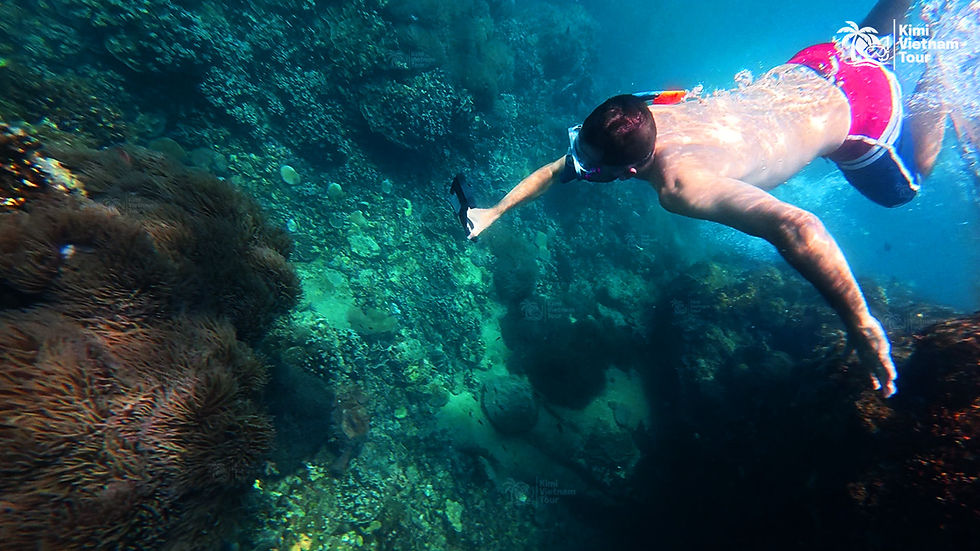
Reading about coral reefs is one thing - floating above a living reef surrounded by colorful fish is something completely different.
At Kimi Vietnam Tour, we specialize in small-group and private snorkeling experiences focused on healthy coral reefs, marine life, and responsible tourism. Every trip is planned according to the actual sea conditions, allowing us to choose the reefs offering the best visibility and the healthiest coral communities on the day of your tour.
Whether you're an absolute beginner, traveling with your family, or an experienced snorkeler or freediver, we'll help you discover the incredible underwater world that inspired this guide.
FAQ
🪸 Can You Identify Corals While Snorkeling?
Absolutely - but with realistic expectations.
On our snorkeling tours, we want every guest to feel like an explorer, whether they're passionate about marine life or simply enjoying a relaxing day in the water. Before entering the sea, we give a short introduction to the reef ecosystem and explain what you are likely to encounter beneath the surface. After each snorkeling session, we review what we observed together using identification cards.
Many of the larger and more distinctive corals can be identified directly in the field, and our guide will point out unusual or particularly interesting species while you're in the water. If we know exactly what you're looking at, we'll explain it. If identification is uncertain, we'll discuss the possibilities - because that's part of marine biology too.
While many coral genera can be recognized by their growth form, identifying every coral to species level is often impossible during snorkeling alone. Numerous species require close examination of their skeletal structure under a microscope, and some can only be confirmed through detailed scientific or genetic analysis.
📸 Why Do Corals Look Different Underwater Than in Photographs?
Several factors influence the colors you see underwater.
The first is light. Water absorbs different wavelengths of light with depth - reds disappear first, followed by oranges and yellows. As a result, the same coral can look completely different at 1 meter (3 ft) than it does at 4 meters (13 ft), even though it hasn't changed at all.
The second factor is the coral itself. Corals naturally display a wide range of colors depending on the species, the amount of sunlight they receive, water movement, and the symbiotic algae (zooxanthellae) living inside their tissues. Different types and densities of these algae, together with the coral's own fluorescent pigments, can produce remarkably different colors - even among colonies of the same species growing on the same reef.
Finally, underwater cameras, dive lights, and strobes restore colors that our eyes lose with depth. This is why photographs often reveal vivid greens, purples, reds, and oranges that may appear much more subdued when viewed from the surface.
🌊 Why do some reefs have more coral than others?
Coral distribution depends on water movement, light, depth, sedimentation, wave exposure, and historical bleaching events. Two reefs only a few kilometers apart can look completely different.
🐠 Why are there so many fish around certain corals?
Different coral species create different habitats. Branching corals provide shelter for juvenile fish, while massive corals offer hiding places for crabs, shrimps, nudibranchs, and many other reef animals.
🤿 Is Snorkeling Enough to See Phu Quoc's Coral Reefs?
Absolutely. One of the things that makes Phu Quoc unique is how shallow many of its healthiest coral reefs are. At locations such as Hon Kim Quy Reef, healthy coral colonies begin in as little as 0.5 meters (1.6 ft) of water and continue gradually into deeper sections of the reef.
As a result, beginners, families with children, experienced snorkelers, freedivers, and scuba divers can all enjoy the same reef. The difference is not what you'll see, but how closely you can observe it. While freedivers and scuba divers can explore the deeper parts of the reef, snorkeling alone is enough to experience Phu Quoc's remarkable coral diversity.
🌡️ Why do healthy corals sometimes appear brown?
Brown is often the natural color of healthy corals because of the microscopic algae (zooxanthellae) living inside their tissues. Bright fluorescent colors are usually most visible under certain lighting conditions, underwater photography, or after diving closer to the colony.
⚪ Is every white coral dead?
No. A white coral may simply be recently bleached and still alive. If stressful conditions improve, many bleached corals can recover by regaining their symbiotic algae. Dead corals are gradually covered by algae, sponges, and other marine organisms.
📅 Why do the same reefs look different throughout the year?
Coral reefs are living ecosystems that constantly change. Seasonal currents, water temperature, storms, coral spawning, bleaching events, and new coral growth all influence how a reef looks from one season - or even one month - to the next.
🧩 Why is coral identification sometimes difficult?
Many coral species change their shape depending on depth, waves, light, and water movement. Some unrelated species also look remarkably similar, which is why scientists often rely on skeletal structure and, increasingly, genetic analysis for accurate identification.
🐙 What animals live inside coral reefs?
Coral reefs are home to far more than just fish. Depending on the reef, you may also encounter nudibranchs, shrimps, crabs, octopuses, sea stars, giant clams, brittle stars, feather stars, sea cucumbers, and many other fascinating marine animals.


