
Phu Quoc Jeep Tour Guide: Everything You Need to Know

A taxi is cheaper. So why pay more for a Jeep tour?
Phu Quoc Jeep Tour Guide: Everything You Need to Know
Because a Jeep was never just four wheels and a steering wheel.
There is something about sitting in an open Jeep, feeling the road through the seat, hearing the engine work, and letting the wind - and sometimes a little salt - hit your face. It is not necessarily the fastest or most comfortable way to travel. And that is exactly the point.
The Jeep became part of a much bigger story long before it became a tourist vehicle. For generations, it has been associated with exploration, remote roads, military history, adventure and the simple idea of going somewhere that an ordinary car might not take you.
A Jeep is something you experience.
On Phu Quoc, the destination is only part of the day. The road itself becomes part of the experience: winding through countryside, passing pepper farms and local villages, heading into the jungle, following smaller tracks and stopping at places you might otherwise simply drive past.
The sights are the bonus.
The ride is the point.
But does that really make a Jeep tour worth paying more for than a taxi?
Let's take the romanticism out of it for a moment and look at the practical question: what do you actually get when you book a Jeep tour in Phu Quoc - and when is a taxi the better choice?
A taxi is cheaper. So why pay more for a Jeep tour?
Because a Jeep was never just four wheels and a steering wheel.
There is something about sitting in an open Jeep, feeling the road through the seat, hearing the engine work, and letting the wind - and sometimes a little salt - hit your face. It is not necessarily the fastest or most comfortable way to travel. And that is exactly the point.
The Jeep became part of a much bigger story long before it became a tourist vehicle. For generations, it has been associated with exploration, remote roads, military history, adventure and the simple idea of going somewhere that an ordinary car might not take you.
A Jeep is something you experience.
On Phu Quoc, the destination is only part of the day. The road itself becomes part of the experience: winding through countryside, passing pepper farms and local villages, heading into the jungle, following smaller tracks and stopping at places you might otherwise simply drive past.
The sights are the bonus.
The ride is the point.
But does that really make a Jeep tour worth paying more for than a taxi?
Let's take the romanticism out of it for a moment and look at the practical question: what do you actually get when you book a Jeep tour in Phu Quoc - and when is a taxi the better choice?
Is a Jeep Tour in Phu Quoc Worth the Money?

Yes - but not because a Jeep is simply a more expensive way to take a taxi.
You can absolutely explore Phu Quoc by taxi. A driver can take you from one place to another, and you can often agree on several stops along the way. If that is all you need, there is no reason to book a Jeep just because it has bigger wheels and looks better in a photo.
But there is a difference between hiring a car for transportation and spending a day exploring the island in a Jeep.
A taxi takes you there. A Jeep stays with you.
A taxi is primarily about getting from A to B.
You can arrange stops, but the driver's job is still to get you where you are going. Waiting around for you, changing the route and spending the whole day following an itinerary is a different kind of service - and it needs to be arranged accordingly.
With a private Jeep tour, the vehicle, driver and route are dedicated to your day.
You are not constantly thinking about where to find the next ride.
You simply keep going.
Where the road ends, the Jeep can keep going
Phu Quoc has changed enormously. Many of the rough dirt roads that once covered the island have disappeared beneath concrete and asphalt.
But not all of them.
There are still smaller tracks, forest roads, countryside paths and remote corners where a normal car is simply not the right tool. A Jeep is not an off-road monster designed to conquer the island, but its higher clearance, open design and rugged construction make it much better suited to places where an ordinary city taxi would rather turn around.
And sometimes the most interesting part of the island starts exactly there.
Then there is something you cannot put into a brochure
Every old Jeep has a history.
Many of the Jeeps used today began life as military vehicles. Some have a history reaching back to the Vietnam War era and the years that followed, while others have been carefully restored and brought back to life as working vehicles.
Look closely and you may see the age in the details - the metal, the paint, the seats, the sounds and the little imperfections that make each vehicle different.
And then there is the person behind the wheel.
Every local driver has a story too.
A driver may know a road that does not appear in your itinerary, remember how a village looked years ago, know which family has been farming the land for generations, or simply have a story about the island that you would never find in a travel brochure.
You will not find all of that on Google Maps.
And you certainly will not get it from the back seat of a taxi ordered for the next destination.
That is what you are really paying for.
Not four wheels.
Not a steering wheel.
Not simply a faster way to reach the beach.
You are paying for a vehicle with character, a driver with local knowledge, a day that does not have to revolve around finding the next ride, and the chance to experience parts of Phu Quoc that are easy to miss when you treat the island as a collection of destinations.
The sights are still the bonus.
The ride is the experience.
What Do You Actually See on a Jeep Tour in Phu Quoc?

Our Phu Quoc Jeep tours offer three different ways to experience the island, depending on how much time you have and what you want to see.
1. Northern Phu Quoc Jeep Tour - Our Most Popular Route
Our most popular Jeep tour takes you through northern Phu Quoc, combining jungle, countryside, local life and the northern coast.
Best for: nature, adventure and exploring the less developed side of the island.
2. Southern & Central Phu Quoc Jeep Tour - A More Relaxed Route
The southern and central route combines nature, culture, countryside and beaches at a more relaxed pace.
Best for: families, couples and travellers who want a varied day without focusing mainly on the jungle.
3. Phu Quoc Jeep Highlights - For Travellers Short on Time
Only have a short time on Phu Quoc but still want to experience the island by Jeep? Combine some of the island's most popular experiences - from the famous Hon Thom Cable Car and southern coast to the magical Starfish Beach in the north.
Best for: first-time visitors and travellers who want a taste of both sides of Phu Quoc without spending several days exploring the island..
Northern Phu Quoc Jeep Tour

Field | Information |
Route | Northern Phu Quoc |
Tour Type | Private Jeep Tour |
Vehicle | Vintage Army Jeep / UAZ |
Capacity | Vintage Army Jeep: maximum 3 guests / UAZ: maximum 5 guests. Larger groups travel together in multiple Jeeps as a convoy. |
Duration | Full day |
Character | Jungle, countryside, local life & Starfish Beach |
Main Highlights | Nguyễn Trung Trực Temple, Cua Can River, pepper & fruit farms, Phu Quoc National Park, wildlife, Starfish Beach & Rach Vem |
Roads | Main roads, countryside roads & smaller tracks |
Best For | Nature, adventure, local life & exploring beyond the resorts |
Popularity | ⭐⭐⭐⭐⭐ Our most popular Jeep route |
Pace | Active but unhurried |
Best Feature | Experiencing the natural and cultural side of northern Phu Quoc |
What Makes It Different | The journey, local knowledge and places between the main attractions |
What Is the Northern Jeep Tour?
The Northern Phu Quoc Jeep Tour is our most popular route for travellers who want to experience more than the developed tourist areas.
The day connects local culture, countryside, tropical rainforest, wildlife, farms, fishing villages and the northern coast. Instead of simply driving from one attraction to another, you gradually move through very different landscapes, from local roads and farms into the rainforest and finally to the sea.
It is also an opportunity to experience Phu Quoc's tropical rainforest and some of its remarkable old trees, including trees with cultural and ecological importance found within the national park.
The route is active, but it is not a difficult trekking tour. Most nature stops involve short and comfortable walks, making the experience suitable for travellers who want to explore the forest without committing to a demanding hike.
⭐ Starfish Beach: Swim, Relax or Look Beneath the Surface

Starfish Beach is one of the best-known natural attractions in northern Phu Quoc, but there is more to do here than simply take a photograph.
You can swim, relax in the shallow water or take a mask and look beneath the surface at the seagrass beds around the beach.
These shallow habitats provide shelter and feeding grounds for a surprising variety of marine life, including starfish, small fish, crabs, shells and other creatures. With calm water and plenty to observe close to shore, it is an easy place to slow down after the journey through the north.
And sometimes the best part is simply sitting down, taking off your shoes and letting the island do the rest.
Shoes off. Feet in the water. Phu Quoc.
🎣 Rach Vem: A Fishing Village on the Water

Rach Vem is not simply another beach stop.
It is a traditional fishing community, with homes built over the water and houses standing on stilts along the coast. The village offers a glimpse into a very different side of life on Phu Quoc, one connected directly to the sea.
Here you can see local fishing life and marine farming, and enjoy a meal prepared from fresh local ingredients while sitting above the water.
It is one of those places where the attraction is not a monument or a viewpoint.
It is the way people live.
🌳 Phu Quoc National Park: Tropical Rainforest Without the Hard Trek

The northern route also takes you into Phu Quoc National Park, where the experience changes from beaches and villages to tropical rainforest.
Our nature stops are designed as easy walks rather than demanding hikes. You can follow forest paths to streams, impressive old trees and species with ecological and cultural importance, including Hopea pierrei.
The forest is also home to wildlife.
You may hear macaques moving through the canopy before you ever see them. Occasionally they can be spotted directly from the Jeep or near the road. Phu Quoc is also home to the rarer langur, although sightings are much less predictable.
These are wild animals, not attractions with a timetable. Seeing them is never guaranteed, and that is precisely what makes the encounter genuine.
One thing you can almost certainly expect to encounter, however, is an incredible variety of butterflies. Large and small, brightly coloured and remarkably shaped, they move through the forest almost like a living dance.
🌶️ Pepper & Fruit Farms: More Than Just Pepper
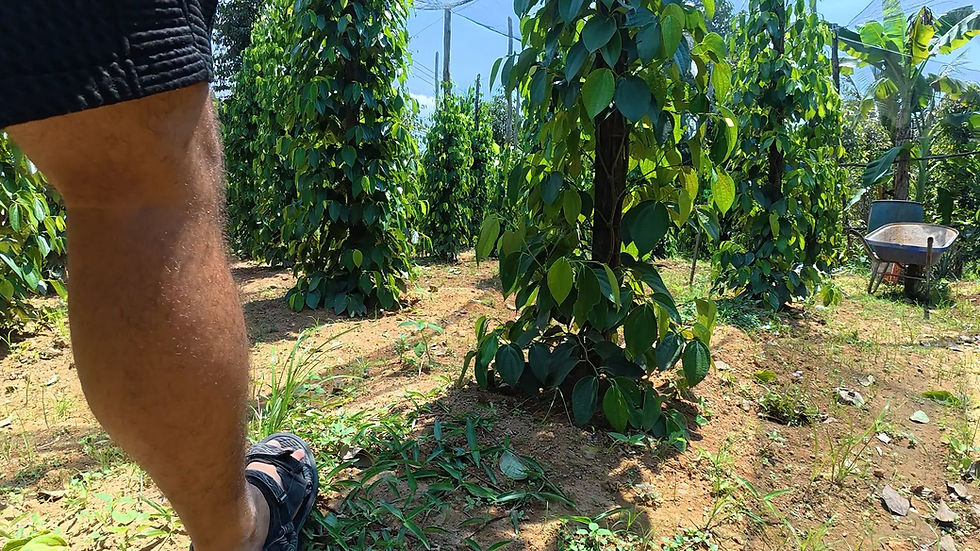
Northern Phu Quoc is also farming country.
Along the route are extensive pepper farms and fruit gardens, where you can see how some of the island's agricultural products are actually grown.
Instead of simply buying fruit at a market, you can see the plants themselves and discover something surprisingly easy to overlook:
What does the fruit actually grow on?
A tree? A bush? A vine?
And then there is Phu Quoc pepper, one of the island's best-known agricultural products.
At the farms, you can see how pepper is cultivated and processed and learn why Phu Quoc has developed such a strong reputation for its pepper production.
Want to know more about Phu Quoc pepper?
🛕 Nguyễn Trung Trực Temple: More Than Another Temple
Nguyễn Trung Trực Temple is not simply another pagoda added to a sightseeing itinerary.
It is dedicated to Nguyễn Trung Trực, a Vietnamese resistance leader and national hero, and connects the northern part of Phu Quoc with an important period of Vietnamese history.
The temple preserves relics associated with his story, including a boat connected to the resistance movement.
Depending on the route and conditions, the visit can also be combined with time on the Cua Can River, where you can explore the river by kayak and observe the vegetation and landscape from the water.
Instead of arriving by road, you can sometimes experience the area from a completely different perspective, paddling towards the temple through the river landscape.
🛻 Why Does the Jeep Matter Here?
You could visit many of these places independently.
But the northern route is not simply a list of destinations.
It is the connection between them: the countryside roads, the smaller tracks, the forest, the villages and the moments when you stop because your driver knows there is something worth seeing.
A taxi can take you to a destination.
A Jeep gives you a reason to enjoy the road there.
💡 Best For
Choose the Northern Phu Quoc Jeep Tour if you want:
🌳 Tropical rainforest and easy nature walks
🌿 Giant and culturally important trees
🐒 Wildlife and butterfly spotting
🌶️ Pepper and fruit farms
🛕 Local history and Nguyễn Trung Trực Temple
🛶 Cua Can River and optional kayaking
⭐ Starfish Beach, swimming and seagrass exploration
🎣 Rach Vem fishing village and seafood
🛻 Smaller roads and the Jeep experience
🏝️ A side of Phu Quoc beyond the main resort areas
This is the route for travellers who want to experience northern Phu Quoc as a place to explore, not simply a collection of tourist attractions.
Southern & Central Phu Quoc Jeep Tour: A More Relaxed Day

Field | Information |
Route | Southern & Central Phu Quoc |
Tour Type | Private Jeep Tour |
Vehicle | Vintage Army Jeep / UAZ |
Capacity | Vintage Army Jeep: maximum 3 guests / UAZ: maximum 5 guests. Larger groups travel together in multiple Jeeps as a convoy. |
Duration | Approximately 6 to 7 hours |
Character | Local life, traditions, traditional products, farms, shopping & beach relaxation |
Main Highlights | Fish sauce, snake farm, pepper farm, silk factory, pearl farm, Ho Quoc Pagoda, Coconut Prison, bird's nest, agarwood, Sim wine & Khem Beach |
Roads | Main roads, countryside roads & smaller tracks |
Best For | Local culture, traditional products, history & relaxed beach time |
Popularity | ⭐⭐⭐⭐☆ |
Pace | Relaxed |
Best Feature | Discovering what Phu Quoc produces, preserves and passes on |
What Makes It Different | A combination of local traditions, production, history, shopping and time at the beach |
What Is the Southern & Central Jeep Tour?
The Southern & Central Phu Quoc Jeep Tour is designed for travellers who want to discover what makes the island more than just beaches and resorts.
Instead of focusing mainly on jungle and wildlife, this route follows the everyday and traditional side of Phu Quoc. Along the way, you can discover how local products are grown, produced and processed, visit places connected with the island's history, experience traditional industries and finish the day with lunch and time to relax at Khem Beach.
It is a slower and more relaxed route, but that does not mean there is less to discover.
The focus is simply different.
Less jungle adventure. More local life, traditions, history, production and beach time.
🐟 Phu Quoc Fish Sauce: A Taste of Island Tradition

Vietnamese cuisine is difficult to imagine without fish sauce, and Phu Quoc fish sauce has been part of the island's culinary tradition for generations.
Traditional fish sauce is made from anchovies and sea salt, then slowly fermented in large wooden barrels. The process takes time, patience and knowledge that has been passed between generations of local producers.
The result is one of the products most strongly associated with Phu Quoc and its maritime culture.
The visit itself is not long, but there is one thing you will probably remember.
The smell. 😄
Once you have experienced the aroma of a traditional fermentation facility, you will not confuse it with an ordinary souvenir shop.
Tasting is part of the experience, and for some travellers, a bottle of genuine Phu Quoc fish sauce becomes the perfect local souvenir. Producers also offer travel-friendly packaging, so taking it home by air is much easier than you might expect.
🐍 Snake Farm: A Less Familiar Side of Vietnam

Many visitors leave Vietnam with a small jar of cobra balm, often presented as a traditional remedy.
Far fewer people ever visit the places where products like these are actually produced.
At the snake farm, you can observe a variety of snakes, including cobras and other venomous species, as well as non-venomous species such as pythons and other reptiles.
The farm also keeps other animals, and the shaded setting makes this a surprisingly pleasant walk despite the unusual inhabitants.
For visitors who are comfortable around animals, it is an opportunity to see these species from a safe distance and learn more about their role in Vietnamese traditional practices.
And perhaps most importantly, it is much better to meet a cobra behind a secure enclosure than unexpectedly on a jungle road. 😄
Phu Quoc is home to several snake species, including venomous ones. Here, you can observe them safely and learn about animals that most visitors would rather not encounter while walking through the countryside.
🌶️ Pepper Farm: From the Plant to the Spice
Phu Quoc is famous for its pepper, but seeing pepper in a shop is very different from seeing how it actually grows.
At a local pepper farm, you can walk among the plants and learn how pepper is cultivated, harvested and processed.
The surrounding farms also reveal another side of Phu Quoc agriculture, with fruit trees and gardens growing alongside the pepper plantations.
You can see where local products actually come from before they reach a market or restaurant.
Want to know more about Phu Quoc pepper?
🧵 Silk Factory: From Thread to Traditional Fabric

The silk factory introduces another traditional Vietnamese product.
Here you can see how silk is produced and processed and learn more about the work involved in turning natural silk fibres into a finished material.
It is a very different experience from simply buying a souvenir in a shop because you can see the production process behind the product.
🦪 Pearl Farm: From Oyster to Pearl

Pearls are among the products most closely associated with Phu Quoc.
At the pearl farm, you can learn how pearls are cultivated and processed, from marine farming to the finished product.
The visit gives you a chance to understand what actually happens during pearl cultivation and how a natural process becomes one of the island's best-known luxury products.
Want to learn more about Phu Quoc pearls?
🪺 Bird's Nest: Made by Birds, Not Twigs

Bird's nest is one of Vietnam's traditional high-value products, but the name can be slightly misleading.
The edible nests are built by swiftlets, small birds related to swifts. Unlike ordinary bird nests made from grass, twigs or leaves, edible bird's nests are constructed largely from the birds' own saliva, which hardens into a lightweight structure.
For centuries, bird's nest has been valued in parts of Asia as a traditional food.
At the farm, you can learn how swiftlets are raised and how their unusual nests are collected and processed. Depending on the visit, you may also see the birds themselves and discover how the nests become finished products.
And yes, you can taste them.
Bird's nest products can appear in drinks, coffee and other prepared foods, giving visitors a chance to experience one of Vietnam's more unusual traditional ingredients.
🌳 Agarwood: The Fragrant Wood of Vietnam
Agarwood has a completely different story.
It comes from trees of the Aquilaria genus. Under certain natural conditions, the tree can develop a dark, fragrant resin within its wood. This resin-rich material has been valued across Asia for centuries for its distinctive aroma and traditional uses.
At the agarwood stop, you can learn how the wood develops its characteristic fragrance, see products made from it and understand why high-quality agarwood can be so valuable.
Where conditions allow, the experience can also include a walk among agarwood trees, connecting the finished product with the living forest from which its story begins.
🍷 Sim Wine: The Taste of Phu Quoc
Phu Quoc's tropical landscape produces more than pepper and seafood.
Sim, the local rose myrtle, produces small berries that have become one of the island's signature traditional products.
The berries grow on shrubs, both on smaller farms and naturally throughout the island's countryside and jungle. They are used to make Sim wine, stronger distilled drinks, syrups, sweets and other local products.
Tastings are part of the experience.
Adults can try the wine and stronger spirits, while children can enjoy Sim sweets and syrups.
And honestly, the candies and syrups are some of our personal favourites. 😄
🛕 Ho Quoc Pagoda: A Temple Above the Sea

Ho Quoc Pagoda is one of the best-known Buddhist temples in southern Phu Quoc, but its setting is what makes the visit particularly memorable.
The complex sits on a hillside overlooking the eastern coast, away from the dense development found elsewhere on the island.
From the temple grounds, the sea opens out below, with the enormous Lady Buddha statue and the wider Buddhist complex creating one of the most striking cultural landscapes in southern Phu Quoc.
There is one simple rule we ask every guest to follow:
Respect for the local culture and religion comes first.
We do not require visitors to arrive wearing long trousers or long sleeves. If you are wearing shorts or a skirt, however, we provide simple visitor robes that can be tied around the waist before entering the sacred areas.
It is practical, respectful and, surprisingly, makes for some memorable photographs.
Photography is welcome around the complex, but we ask visitors not to take photographs inside the temple buildings. The interior is a place of worship, and respecting that space is more important than getting another photograph.
🏛️ Coconut Prison: Remembering a Difficult Past

Coconut Prison, also known as Phu Quoc Prison, is one of the island's most important historical sites.
It preserves the memory of prisoners held there during periods of war and presents a much darker chapter of Phu Quoc's history.
It is not an easy attraction and it is certainly not intended as entertainment.
Some periods of history cannot simply be put back where they came from. They remain part of the island's cultural memory and should not be forgotten.
For visitors who find the subject difficult, the stop can be shortened or skipped.
🏖️ Khem Beach: Lunch, Swimming & Time to Relax

After the farms, production sites and historical stops, the pace changes.
Khem Beach is where you can have a traditional local lunch, swim and simply relax beside the sea.
This is deliberately not another rushed sightseeing stop.
You have time to sit down, enjoy the food, take a swim or simply stay by the water.
And getting there is part of the Jeep experience too. The final approach includes smaller and rougher roads, where the Jeep feels much more at home than a normal city car.
🛍️ Local Products & Souvenirs
One of the advantages of visiting these farms and production sites with a local guide is that you can understand what you are actually buying.
Instead of walking into a souvenir shop and choosing something at random, you can learn about fish sauce, pepper, pearls, silk, bird's nest, agarwood, Sim wine and other local products.
If something catches your interest, your guide can help you choose authentic local products and souvenirs and explain what you are actually taking home.
🛻 Why Go by Jeep?
You could visit many of these places independently by taxi or motorbike.
But this route is not simply a collection of shops, farms and attractions.
The Jeep connects them into one continuous day, with your own driver and guide staying with you throughout the route.
There is no need to arrange a new ride after every stop, negotiate waiting times or decide where to go next.
And then there is the final journey to Khem Beach.
This is where the road itself becomes part of the experience.
💡 Best For
Choose the Southern & Central Phu Quoc Jeep Tour if you want:
🌴 Local life and Vietnamese traditions
🐟 Traditional Phu Quoc fish sauce
🌶️ Pepper and agricultural farms
🐍 Snakes and local traditional products
🧵 Silk production
🦪 Pearl cultivation
🪺 Bird's nest and swiftlet farming
🌳 Agarwood and traditional products
🍷 Traditional Phu Quoc Sim wine
🛕 Ho Quoc Pagoda
🏛️ Phu Quoc's wartime history
🛍️ Authentic local products and souvenirs
🏖️ Khem Beach, local lunch and swimming
🛻 A relaxed Jeep experience with some rougher roads
This is the route for travellers who want to understand what Phu Quoc produces, remembers and preserves, while still leaving time to enjoy the beach.
Phu Quoc Jeep Highlights Tour: South to North in One Day

Field | Information |
Route | Southern & Northern Phu Quoc |
Tour Type | Private Jeep Tour |
Vehicle | Vintage Army Jeep / UAZ |
Capacity | Vintage Army Jeep: maximum 3 guests / UAZ: maximum 5 guests. Larger groups travel together in multiple Jeeps as a convoy. |
Duration | Full day |
Character | Islands, cable car, jungle, beach & local experiences |
Main Highlights | Pearl farm, Sunset Town, Hon Thom Cable Car, water park, northern jungle roads & Starfish Beach |
Roads | Main roads, countryside roads & smaller tracks |
Best For | First-time visitors, limited time & travellers wanting a taste of both sides of Phu Quoc |
Popularity | ⭐⭐⭐⭐☆ |
Pace | Full but varied |
Best Feature | Experiencing both the developed south and natural north in one day |
What Makes It Different | Combines the Hon Thom Cable Car with the northern side of Phu Quoc |
What Is the Phu Quoc Highlights Jeep Tour?
Only have limited time on Phu Quoc but still want to experience more than one part of the island?
This route combines selected highlights from southern and northern Phu Quoc into one full day.
You will see the modern side of the south, cross the sea by one of Phu Quoc's most famous cable cars, then head north towards jungle roads and finish at Starfish Beach.
It is not designed to show you everything.
It is designed to give you a taste of very different sides of Phu Quoc in one day.
🦪 Pearl Farm: One of Phu Quoc's Signature Products
The day begins with a short introduction to one of Phu Quoc's best-known products.
At the pearl farm, you can see how pearls are cultivated and processed and learn more about the industry behind the jewellery sold across the island.
Want to know more about Phu Quoc pearls?
🌅 Sunset Town: The Modern Face of Southern Phu Quoc
From traditional island products, the route moves into something completely different.
Sunset Town is one of the most developed areas of southern Phu Quoc, with colourful Mediterranean-inspired architecture, viewpoints and access to the Hon Thom Cable Car.
It is a quick look at the modern, entertainment-focused side of the island before the journey continues over the sea.
🚡 Hon Thom Cable Car: Across the Sea to Hon Thom
The Hon Thom Cable Car is one of the signature experiences of southern Phu Quoc.
The journey crosses the sea towards Hon Thom, offering wide views over the islands, fishing boats and turquoise water below.
On Hon Thom, you have time to enjoy the water park and buffet, making this part of the day a combination of scenery, food and entertainment.
Want to know more about the Hon Thom Cable Car?
🌳 Northern Jungle Roads: A Change of Scenery
After the developed south and the cable car, the route heads north.
The landscape gradually changes as you leave the busiest tourist areas behind and travel through countryside and jungle roads.
This section is deliberately not another long sightseeing stop.
It is about seeing how quickly Phu Quoc can change from developed tourist areas to green countryside and forest.
⭐ Starfish Beach: Finish by the Sea
The final stop is Starfish Beach in northern Phu Quoc.
Here you can slow down, swim, relax or use a mask to look into the shallow water and seagrass areas where starfish and other small marine life can be found.
After a full day crossing the island, it is a simple way to finish.
Shoes off. Feet in the water. Phu Quoc.
🛻 Why Choose This Route?
This is not the route to choose if you want to explore the north or south in depth.
It is for travellers who have limited time on Phu Quoc but still want to experience the island by Jeep.
Instead of spending the whole day in one area, you get a little of both:
South. Cable car. Islands. Jungle. North. Starfish Beach.
💡 Best For
Choose the Phu Quoc Highlights Jeep Tour if you want:
🦪 Phu Quoc pearl farming
🌅 Sunset Town
🚡 Hon Thom Cable Car
🌊 Water park & buffet
🌳 Northern jungle and countryside roads
⭐ Starfish Beach
🛻 A Jeep experience
⏱️ Maximum variety when your time on Phu Quoc is limited
This is the route for travellers who do not have enough time to explore Phu Quoc slowly, but still want to experience more than one side of the island.
Which Phu Quoc Jeep Tour Is Right for You?

🌳 Northern Phu Quoc Jeep Tour → Jungle, wildlife, farms, Rach Vem & Starfish Beach
🌴 Southern & Central Jeep Tour → Local life, traditions, production, history & Khem Beach
Choose your route and let the Jeep do the rest. Frequently Asked Questions About Phu Quoc Jeep Tours
How many people can travel in one Jeep?
Our Vintage Army Jeep carries up to 3 guests, while the UAZ can carry up to 5 guests. Larger groups can travel together in several Jeeps as a convoy.
Which Phu Quoc Jeep Tour should I choose?
Choose the Northern Jeep Tour for jungle, wildlife, farms, Rach Vem and Starfish Beach. Choose the Southern & Central Tour for local products, traditions, history and a more relaxed beach day. The Highlights Tour is best if you have limited time and want to combine the south and north.
Is a Jeep tour suitable for families with children?
Yes. The tours are suitable for families, although the Northern route includes more walking and nature exploration. For younger children, the Southern & Central route is generally the more relaxed option.
Is the Jeep tour private?
Yes. You have your own Jeep, driver and guide. You are not sharing the vehicle with other unrelated guests.
Can a larger group travel together?
Yes. For larger groups, we arrange multiple Jeeps and they travel together in a convoy, following the same route and stops.
Are the Jeep roads really off-road?
Not throughout the entire tour. Phu Quoc now has an extensive road network, but smaller countryside tracks and rougher sections still exist. These are where the Jeep experience becomes particularly noticeable.
Do I need to be fit for the Jeep tours?
No special fitness is required. The Northern tour includes easy nature walks, but it is not a demanding trekking tour. The Southern & Central route is generally more relaxed.
What should I bring on a Jeep tour?
Bring comfortable clothes, sunscreen, sunglasses, swimwear and a towel. A little dust and wind are part of the Jeep experience, so clothes you do not mind getting dusty are a good idea.
Can I swim during the Jeep tours?
Yes. The Northern route includes Starfish Beach, while the Southern & Central route includes Khem Beach, where you have time for swimming and relaxation.
What happens if it rains?
The tour operates according to local weather and road conditions. If conditions become unsafe, the route can be adjusted or the tour may be canceled for safety reasons.
Can I book a Jeep tour for a large family or group?
Yes. Tell us your group size when booking and we can arrange the appropriate number and type of Jeeps.
Why is a Jeep tour more expensive than simply taking a taxi?
Because you are not paying only for transportation. You are booking a private vehicle, driver, guide, planned route, stops and a full-day experience. The Jeep itself is also part of the experience.
Still deciding? Start with the route that matches what you want to see.


